Beyond NPS: 5 Metrics That Actually Predict Client Churn in 2026

Introduction
NPS captures client sentiment right now. Not what they're planning next. I've seen companies toast 70+ NPS scores while those same clients drafted cancellation emails in the background.
Sentiment surveys overlook the behavioral signals that count.
Usage declines show up 30-90 days before cancellation. Revenue contraction patterns reveal dissatisfaction ahead of any survey response. Executive disengagement destroys renewals even when NPS scores hold steady. Harvard Business Review research on NPS limitations validates what I've observed across 52 SaaS engagements.
Five metrics that genuinely forecast client churn. They blend into a weighted health score that identifies risk before you lose the account.
Why NPS Fails as a Churn Prediction Tool
NPS captures sentiment at one moment. It misses the behavioral shifts that signal cancellation. Response bias pushes data toward extremes.
Quarterly surveys? They create prediction gaps.
The Quarterly Survey Problem
Most companies gather NPS data quarterly or annually. Clients who leave often skip that final survey. The timing delay turns NPS reactive instead of predictive. Dissatisfied clients abandon surveys before abandoning your product. Once NPS dips, the exit decision is already locked in.
Real-time behavioral signals outperform delayed sentiment polls.
What 52 SaaS Engagements Taught Us About Sentiment vs Behavior
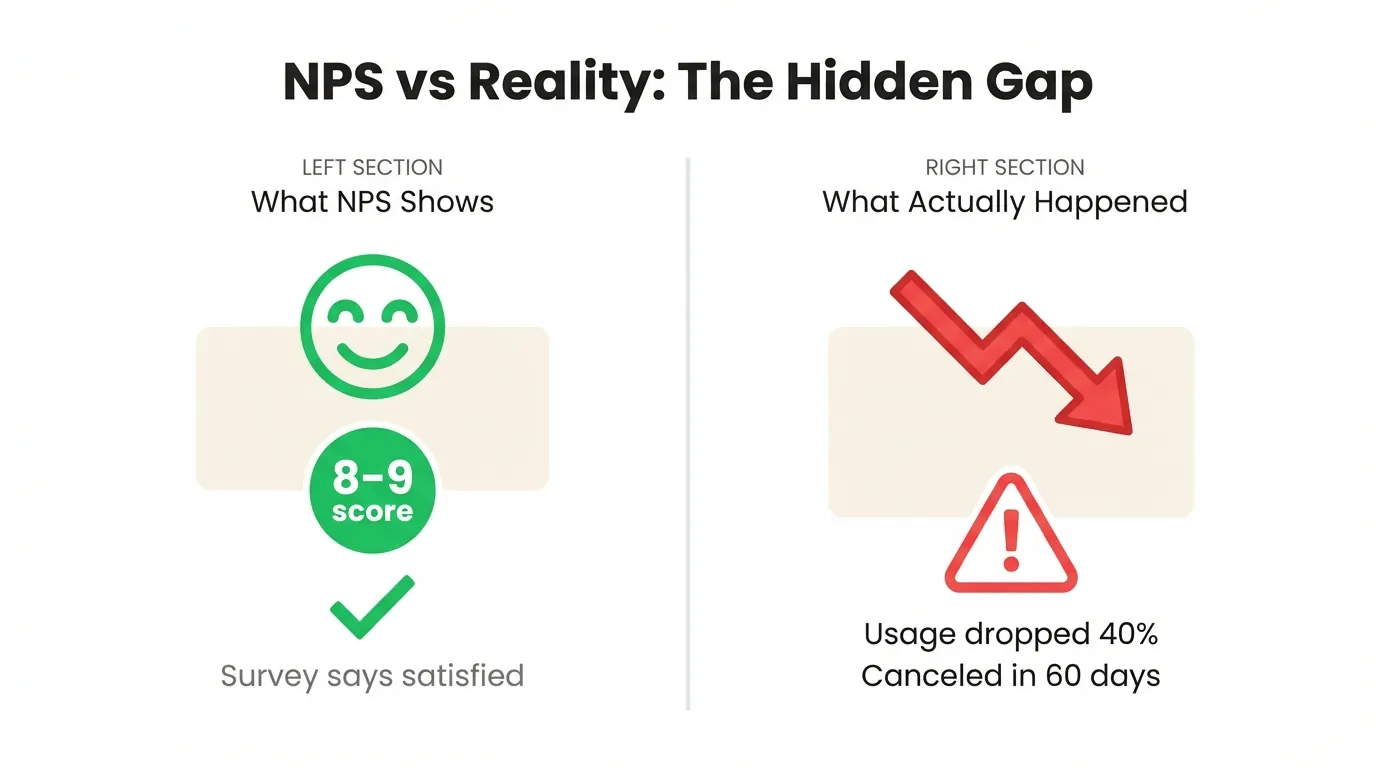
I've watched accounts with NPS scores of 8-9 cancel within 60 days. Those surveys reflected satisfaction with prior service, not plans for the future. Usage had fallen 40% before the survey even launched. Seat reductions occurred while NPS remained raised. Customer satisfaction research confirms behavior predicts outcomes more reliably than sentiment.
Metric #1: Product Usage Trend Analysis
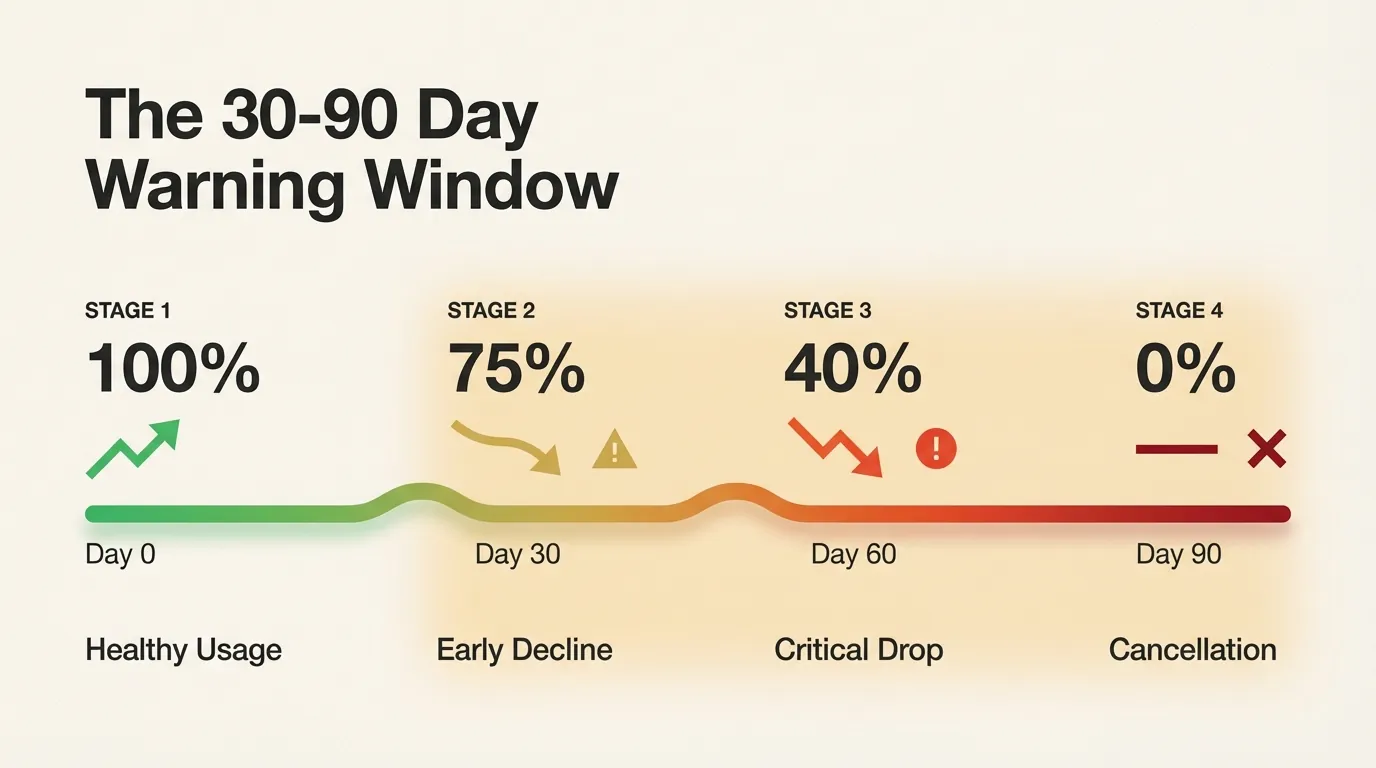
Declining usage predicts churn better than anything else. The drop happens 30-90 days before customers cancel.
When core feature activity falls 25-40%, you're looking at high churn risk. Companies watch login counts while missing the patterns that actually count.
Monitor 7-day trends instead of monthly averages.
Weekly checks catch problems while you can still fix them.
The 30-90 Day Warning Window
Falling usage creates intervention opportunities. Product engagement research confirms this pattern holds true across B2B SaaS. Customers pull back on usage first, spending cuts come later.
Active user trajectories tell you more than single-point measurements. Someone logging in daily but touching zero core features? Already lost. How intensely they use the product beats how often they sign in.
What to Track Beyond Login Frequency
Start with core feature adoption rates. These features deliver your product's main value proposition. Monitor 7-day active usage for catching immediate engagement changes. Look at 30-day usage deltas to see if accounts expand or contract. Usage analytics methodology offers frameworks for measuring what actually drives retention.
Metric #2: Revenue Expansion and Contraction Behavior
Accounts that shrink once are 3-5x more likely to churn next cycle. Revenue contraction is a behavioral statement about perceived value.
Seat reductions scream dissatisfaction louder than survey responses.
Why Seat Reductions Are Your Loudest Alarm
Downgrades indicate value isn't matching price perception. Clients don't reduce seats on products they consider essential. Module removals signal specific features aren't delivering expected ROI. Feature tier downgrades suggest budget pressure or value misalignment. Revenue retention data confirms contraction predicts full cancellation.
Shrinkage is a test run for leaving.
Scope decreases often precede complete cancellation by 60-90 days. Track every revenue movement, not just net retention.
Tracking Scope Decreases and Feature Downgrades
Monitor module removals with the same urgency as usage drops. Feature downgrades reveal which capabilities clients don't value enough to pay for.
Metric #3: Executive Sponsor Engagement and Stakeholder Depth
B2B churn clusters around two events: champions exit or budget owners go dark.
Executive sponsors who vanish for 60+ days signal raised churn risk. Accounts tied to one relationship collapse faster because there's no depth to absorb the shock.
The 60-Day Executive Disengagement Rule
Sixty days of executive silence marks a critical threshold. I saw a $180K account disappear after the VP who backed us departed. When budget owners retreat, internal political vulnerability skyrockets. B2B buying complexity research confirms decisions pull in 6-10 stakeholders. Monitor time elapsed since final interaction across every stakeholder tier.

Meeting attendance patterns expose engagement depth more accurately than email opens.
Multi-Threading: Why Single-Contact Accounts Churn Faster
Spread relationships across the organization with intent. Champion departures destroy renewals when you've constructed a single failure point. Quantify contact depth per account, not merely contact volume.
Monitor decision-maker engagement distinct from user engagement.
Metric #4: Time-to-Value Realization and ROI Perception
Clients without tangible early wins show lower renewal rates. When perceived value drops below expected value, churn risk climbs.
Measure the gap from onboarding to first documented business outcome.
The First-Result Window That Determines Renewal Fate
Survey value perception at 30, 60, and 90-day milestones. Document specific ROI metrics clients expected versus what they achieved. Value realization insights emphasize early wins drive retention. Time-to-first-result matters more than feature count.
Expectation versus reality. That gap determines renewal fate.
Measuring Perceived Value vs Expected Value Gap
Positioning mismatch during sales creates unrealistic expectations that guarantee churn. Monitor whether clients are achieving the outcomes they signed up for. Companies experiencing churn often find the root cause is positioning mismatch attracting wrong-fit clients, or lack of systematic value demonstration between renewals.
Metric #5: Support Friction and Customer Effort Score
Relationships requiring excessive effort burn through goodwill faster than anything else.
When accounts experience multiple unresolved problems within 30 days, you're looking at powerful churn indicators. Escalation patterns expose frustration long before customers voice complaints.
The 30-Day Multiple-Issue Threshold
Monitor how long issues take to resolve and how often each account contacts support again. Escalations eat away at goodwill with brutal speed. Customer effort research demonstrates that friction signals churn more accurately than satisfaction metrics. Each SLA breach builds resentment that grows exponentially. Pay attention to how much work clients must invest just to extract value from what they bought.
Customer effort scores expose friction hiding inside accounts that appear fully engaged. Customer experience insights validate that low-effort interactions fuel retention.
Why High-Touch Accounts Often Hide Churn Risk
When support tickets pile up, you might be dealing with product complexity or inadequate onboarding. Companies bleeding customers frequently trace problems back to positioning that attracts poor-fit prospects, or missing systematic proof of value between renewal cycles.
Building Your Weighted Health Score Framework
One metric alone won't predict churn perfectly. You need behavioral, financial, and relational data working together to create real prediction accuracy.
Weight each metric according to how well it actually predicts outcomes in your specific business.
The Five-Component Scoring Model
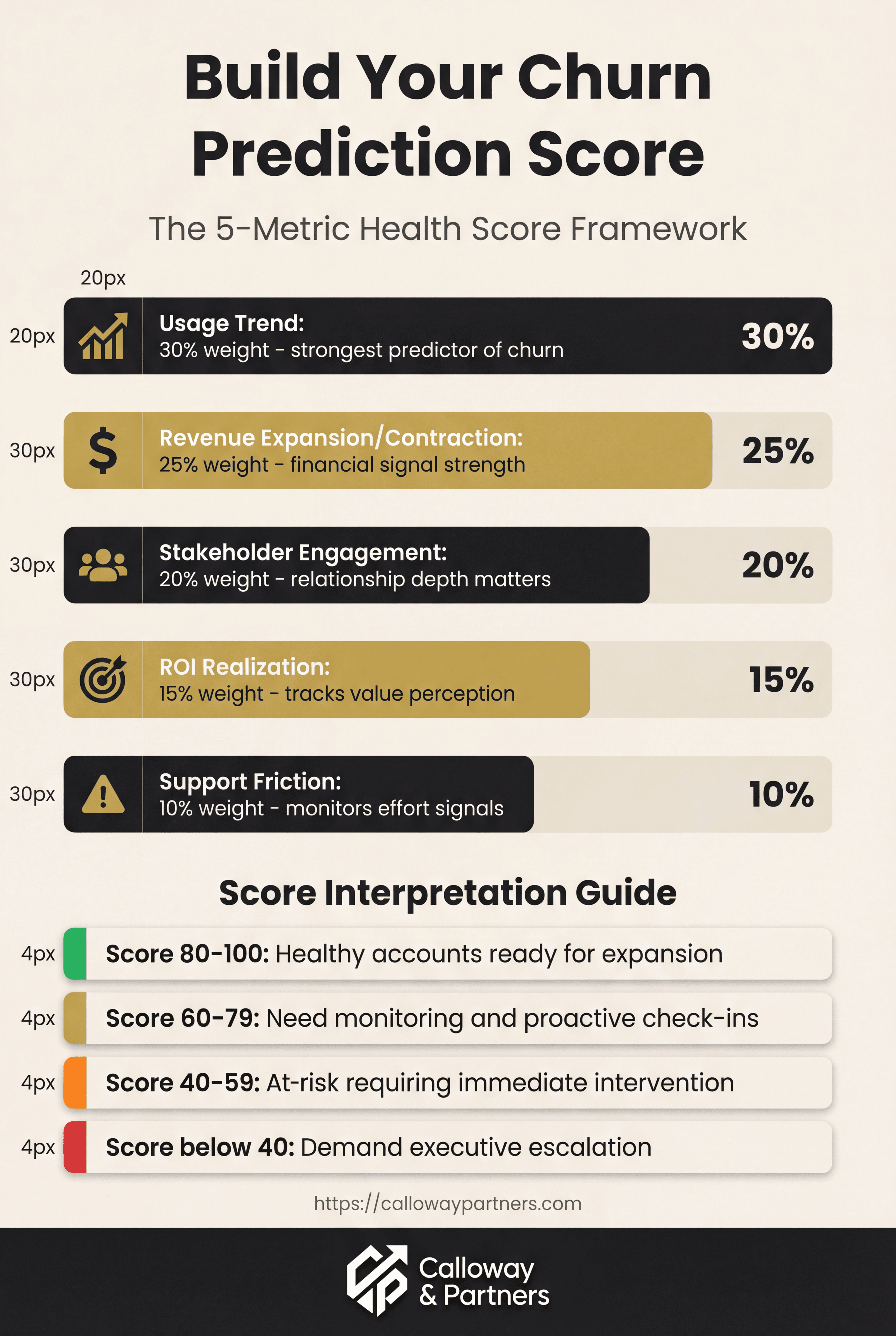
- Usage Trend - 30% weight as your strongest predictor
- Revenue Expansion or Contraction - 25% weight for its financial signal strength
- Stakeholder Engagement - 20% weight because relationship depth matters
- ROI Realization - 15% weight to track value perception
- Support Friction - 10% weight for monitoring effort signals
Tweak these percentages to match your business model and customer lifecycle. Focus on trends instead of snapshots.
Validate your model against historical churn data.
Score Ranges and Action Triggers
- 80-100 - Healthy accounts ready for expansion conversations
- 60-79 - Need monitoring and proactive check-ins
- 40-59 - At-risk accounts requiring immediate intervention
- Below 40 - Demand executive escalation and rescue planning
Create intervention playbooks for each score range.
Conclusion
Track these five metrics every week instead of quarterly. Create your weighted health score based on what matters for your business. Leading indicators shift customer success from putting out fires to preventing churn before it happens.
Perfect metrics don't exist.
Combining these measures produces prediction accuracy NPS can never match on its own.
Watch how trends develop instead of relying on single data points, measure engagement depth across all stakeholders, and make early value delivery your top priority.