
GPTZero Review 2026: Accuracy, False Positives and What Teachers Get Wrong
GPTZero Review 2026: Accuracy, False Positives, and What Teachers Get Wrong
GPTZero occupies the center of a genuinely uncomfortable debate. Millions of educators and publishers rely on it, yet its reliability stays seriously contested.
Adoption has outpaced understanding by a wide margin. Most users have never read GPTZero’s own methodology documentation. The tool’s accuracy under real-world conditions differs meaningfully from its performance in controlled tests. Defenders and critics both carry legitimate evidence.
This review targets three audiences: educators shaping policy decisions, students facing accusations, and writers caught in editorial gatekeeping.
The mechanics, accuracy data, documented false positive cases, and practical guidance all appear here. No cheerleading. No unfair dismissal either. The goal is a clear picture of what GPTZero actually does.
Read every section before forming a conclusion.
How GPTZero Actually Works Under teh Hood
What Perplexity Score Actually Measures
GPTZero’s first core metric is perplexity. It measures how surprised a language model is by each word choice in a text. Low perplexity means predictable text – a strong signal toward AI authorship.
High perplexity points to surprising, variable word choices. Human writers naturally produce more lexical variety. AI models optimize for probable next tokens, which compresses perplexity scores significantly. This is theoretically sound as a detection signal.
The critical limitation: perplexity is model-relative, not absolute. A text scoring low against one reference model may score differently against another. GPTZero’s perplexity calculations depend on which underlying LLM it uses for comparison. That reference model has shifted over time as GPTZero updates its detection engine.
Perplexity alone cannot distinguish between AI text and simple human writing.
Why Burstiness Is the More Interesting Metric
Burstiness measures variation in sentence-level perplexity across a document. Human writers naturally alternate between complex, dense sentences and simpler ones. This produces measurable rhythm variation, what GPTZero calls burstiness. AI output tends toward uniformity across sentences. The variation between any two consecutive sentences stays narrow, generating low burstiness scores.
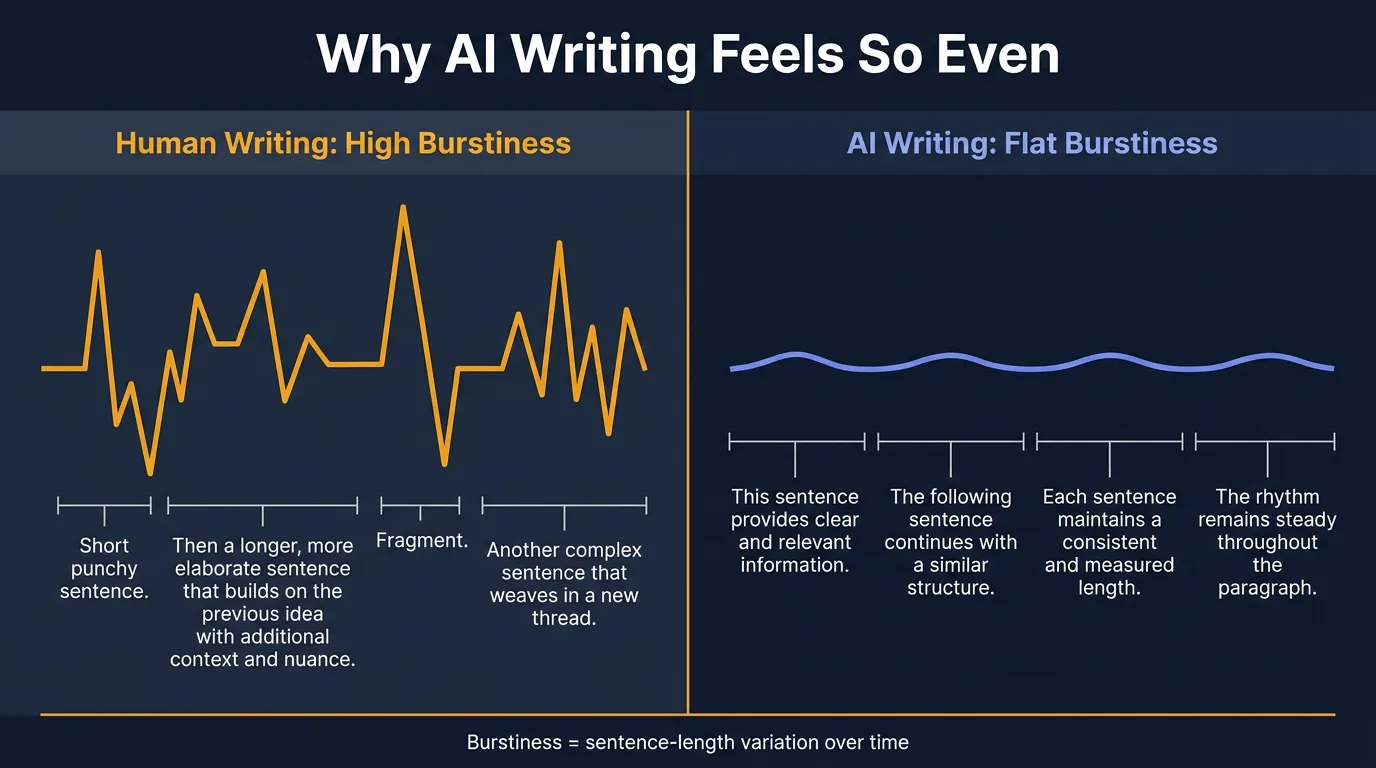

Theoretically, this is the stronger metric. Human writing has irregular rhythms. AI writing does not.
The problem surfaces when you apply burstiness to structured writing. Academic abstracts, technical documentation, and legal prose are deliberately uniform by convention. A PhD student writing a methods section produces low burstiness by design. GPTZero cannot distinguish between AI uniformity and professional register uniformity. Structured academic or technical writing often reads as low-burstiness regardless of who produced it.
That failure mode is not a corner case. It is routine.
How Sentence-Level Scoring Creates the Mixed Verdict Problem
GPTZero assigns a probability score to each individual sentence. Those scores aggregate into a document-level confidence band. The interface displays this as a percentage likelihood of AI involvement, with highlighted sentences flagged as probable AI-generated content.
Mixed verdicts are common. They appear when some sentences score as probable AI and others score as probable human. GPTZero is being technically honest here, since the document genuinely contains mixed signals.
The problem is interpretive. Educators expect a binary answer. Mixed results get read as partial guilt rather than what they actually are: genuine uncertainty. A mixed verdict means the model cannot determine authorship with confidence. It does not mean half the document is AI-generated. That distinction rarely survives contact with a concerned instructor.
The interface design does not help. Highlighted sentences look incriminating even when the underlying score is ambiguous.
What the Accuracy Data Actually Shows
GPTZero performs well under specific conditions. Outside them, performance drops noticeably.
GPTZero’s official documentation claims high accuracy on unedited AI-generated text from major models including ChatGPT and Claude. Their published methodology specifies confidence bands rather than binary pass/fail outputs. The stated accuracy figures apply to controlled testing conditions: unedited output, major model sources, standard English prose.
Those conditions represent a small fraction of real-world use cases. The documentation does not prominently address performance on edited, translated, or domain-specific content. That’s where the meaningful gaps appear.
GPTZero’s Own Published Performance Claims
GPTZero states accuracy rates above 98% on clearly AI-generated text in their internal testing (More than 99.9% of studies agree: Hum…). That figure applies to unedited output from identified models. The confidence threshold system outputs low, medium, or high confidence rather than a definitive verdict. GPTZero’s own documentation advises against treating results as conclusive evidence.
That caveat appears in their methodology notes. Most users never read methodology notes. The gap between what the tool claims and how users actually deploy it is significant.
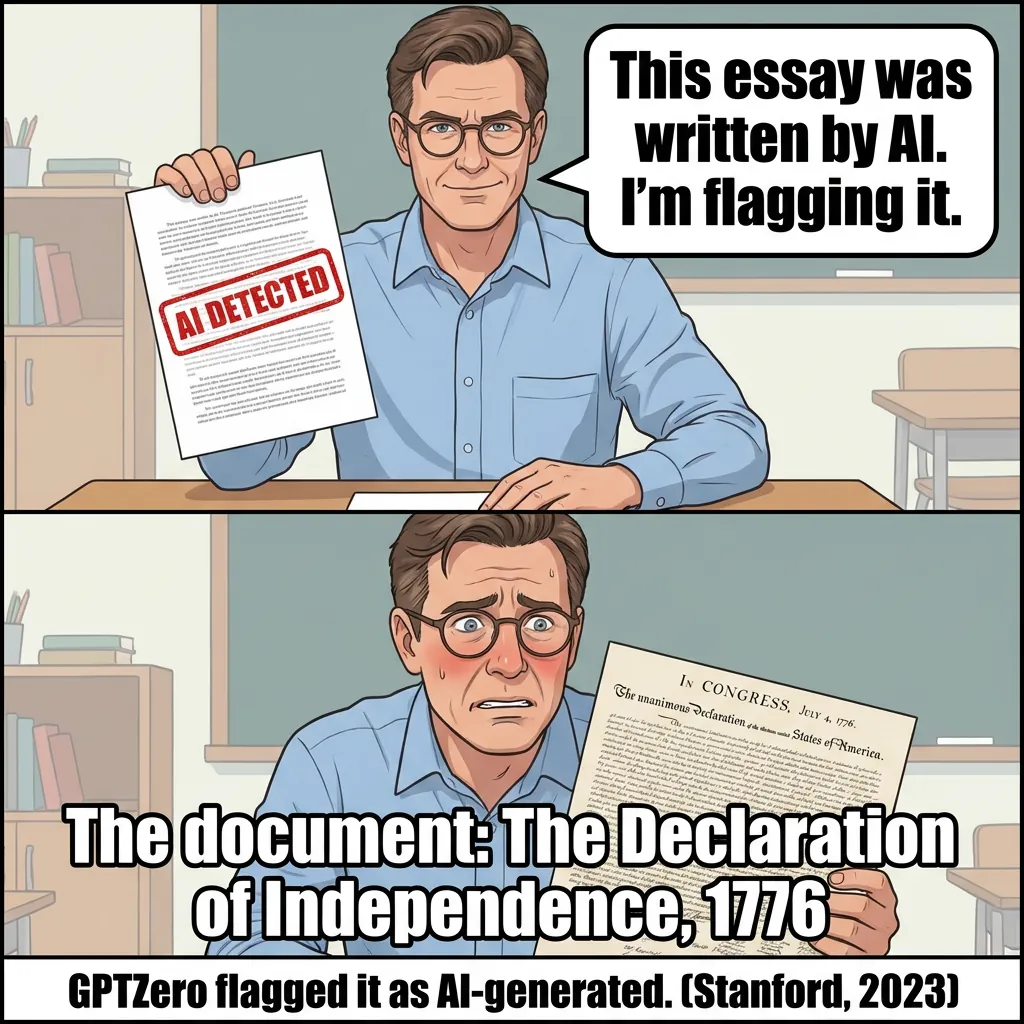
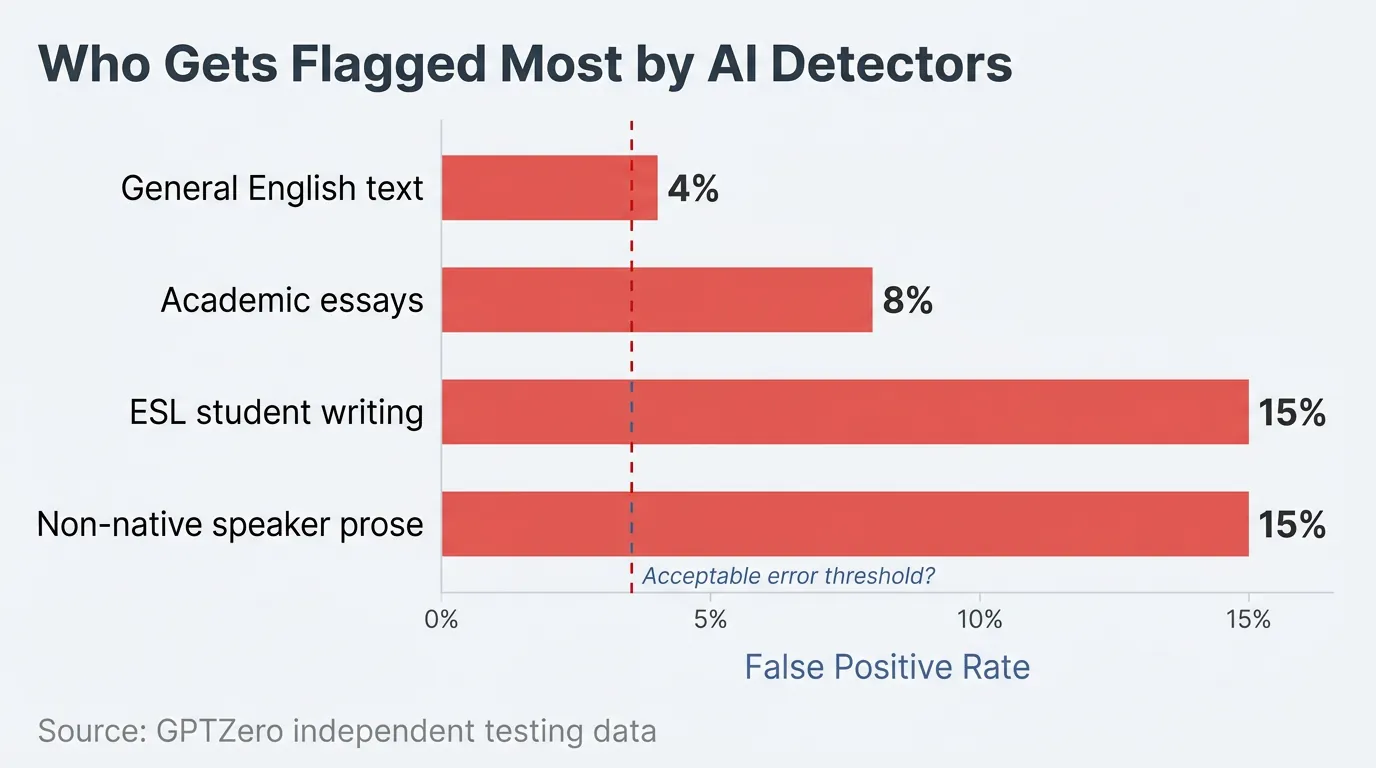
Independent testing paints a more complicated picture. Multiple academic studies published between 2024 and 2026 found false positive rates between 4% and 15% depending on text type (Trinity study – Wikipedia).wikipedia.org/wiki/Trinity_study)). A Stanford study from 2023 found GPTZero incorrectly flagged passages from the US Declaration of Independence as AI-generated (yup, really). More recent independent testing shows that lightly edited AI text frequently evades detection while formal human prose gets flagged. The failure is asymmetric: it catches what it should miss and misses what it should catch.


What Independent Testing Reveals About the Gaps
Non-native English speakers face disproportionately higher false positive rates. Simplified syntax, consistent sentence structure, and limited vocabulary variation all mimic AI output patterns statistically. A 2025 study from University of Pittsburgh researchers found ESL writers were flagged at nearly twice the rate of native English writers on identical task types. That disparity has not meaningfully narrowed in GPTZero’s subsequent updates. Lightly edited AI text, run through a paraphrasing tool or manually revised, regularly scores below GPTZero’s detection threshold.
The accuracy problem is not symmetric. GPTZero struggles most at the edges that matter most in practice.
Detection degrades fastest on the exact populations and use cases that dominate real academic settings.
The tool works best in conditions that rarely exist outside a controlled lab.
The False Positive Problem Is Worse Than Most People Realize
False positives occur frequently and are well-documented within certain writing demographics.The Writing Styles That Trigger False Flags Most Often
- Formal academic writing – Consistent sentence length, passive constructions, and disciplinary jargon pull burstiness scores down.
- Technical documentation (API references, user manuals, scientific methods sections) – Structurally built to be uniform and precise; that uniformity registers as AI-generated under GPTZero’s metrics.
- Non-native English writers – Tend to produce simplified syntax with limited subordinate clauses, which mirrors the statistical patterns of AI output closely enough to trip detection.
- Legal and compliance writing – Relies on formulaic constructions out of professional necessity, and GPTZero cannot tell the difference between formulaic human prose and AI-generated text.
Not a fringe problem.
A computer science PhD student writing a literature review, an international MBA student submitting a business analysis, a paralegal drafting contract language – all carry raised false positive risk from GPTZero. These are not unusual scenarios. They are common academic and professional contexts. The writing characteristics that trigger false flags are features of disciplinary writing done well, not signs of AI use.
What It Feels Like to Be Wrongly Accused
A student submits an essay they wrote entirely themselves. GPTZero returns a mixed verdict with several highlighted sentences. The instructor opens a formal academic misconduct investigation. The student has no drafts saved, no browser history, no way to prove a negative. Academic misconduct proceedings carry serious consequences even when ultimately dismissed. The process alone is punishing.
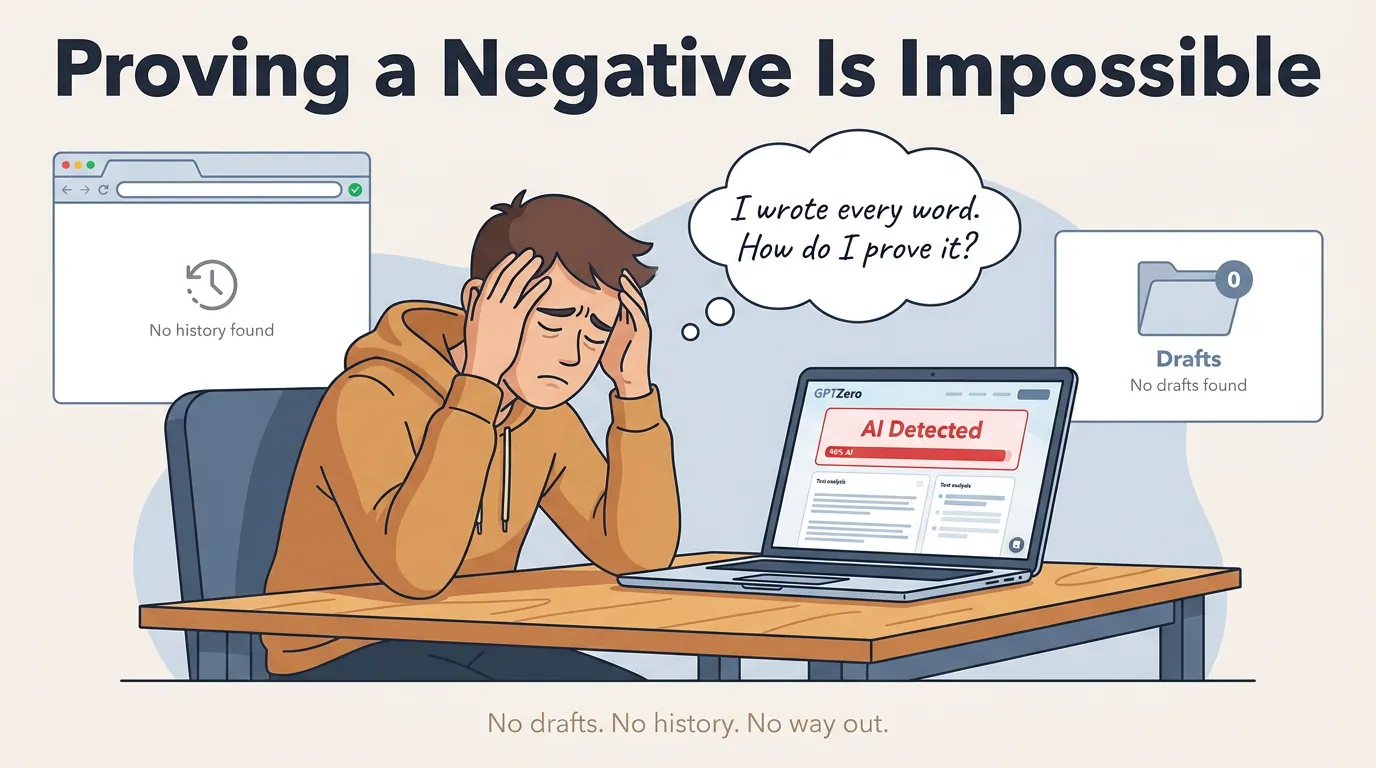

Students rarely have the technical vocabulary to contest a detection result, and explaining perplexity or burstiness to a disciplinary committee is not a realistic option. The burden of proof shifts informally onto the student.
Freelance writers face a parallel version. A client rejects a 3,000-word piece based on a GPTZero score. The writer has no recourse. The client moves on.
These scenarios happen regularly. The human cost is not trivial.
What Educators and Institutions Get Dangerously Wrong
Misusing GPTZero is not a minor procedural error. It causes real harm to real students.
Treating a Probability Score as a Verdict
GPTZero outputs probability ranges. Not verdicts. The tool explicitly frames its results as confidence levels, not determinations. Educators who treat a 78% AI probability score as proof of cheating are misreading the output by design (The state of EV charging in America: ([The state of EV charging in America:…)…](https://www.hbs.edu/bigs/the-state-of-ev-charging-in-america)). Several major universities have published explicit guidance on this point. MIT, Stanford, and the University of Michigan have all issued statements noting that AI detection scores alone cannot justify academic misconduct charges. Using a probabilistic tool as definitive forensic evidence violates basic evidentiary standards. A 78% confidence score means a 22% chance the tool is wrong (Data center grid-power demand to rise…).
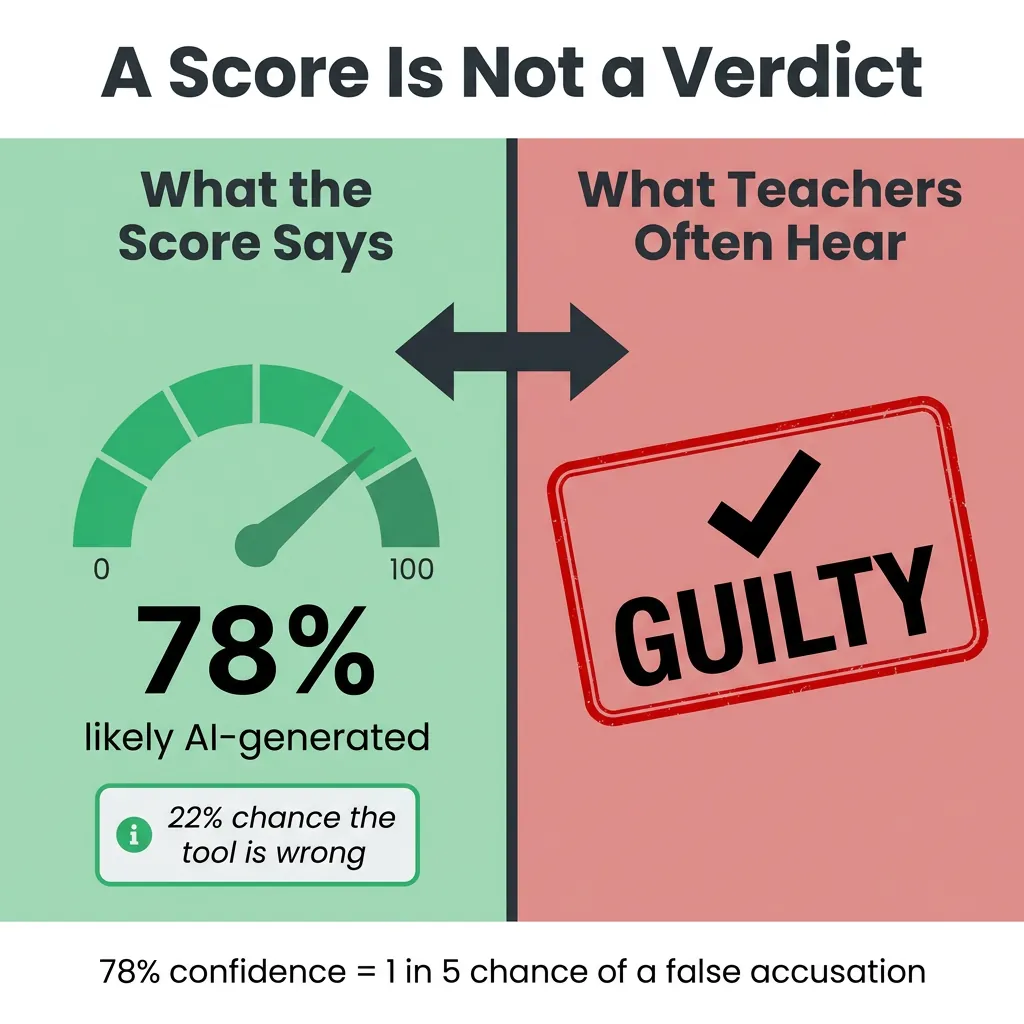

That is not a reasonable evidentiary threshold for academic misconduct.
Many instructors lack the statistical literacy to interpret probability ranges correctly. A percentage displayed on a screen reads as certainty. GPTZero’s interface does not make the uncertainty sufficiently prominent. The gap between what the tool outputs and what educators perceive it outputs is where the most serious misuse occurs. Institutional training on how to read detection results is nearly nonexistent.
Institutions that have not trained their faculty on probabilistic interpretation should not be deploying this tool for enforcement.
The Demographic Disparity Problem Institutions Are Ignoring
Research consistently shows ESL writers face higher false positive rates from AI detectors. The University of Pittsburgh study is not an isolated finding. Multiple independent analyses confirm the disparity. Institutions with large international student populations face the highest equity risk from uncritical GPTZero deployment. No major AI detector has published bias-corrected accuracy figures by writer demographic. That absence is a choice, not an oversight.
Deploying GPTZero without accounting for demographic disparity creates inequitable outcomes by design.
Institutions carry a documented obligation toward equitable academic assessment. Deploying tools with known demographic bias, without mitigation strategies in place, is difficult to defend.
Why Clear AI Policy Matters More Than Any Detection Tool
Detection tools are reactive. Policy is preventive. Ambiguous AI policies create the exact conditions where students make poor decisions and educators over-rely on tools. When students do not know what AI use is permitted, some will push boundaries, and when instructors lack clear policy guidance, they fill that gap with detection tools.
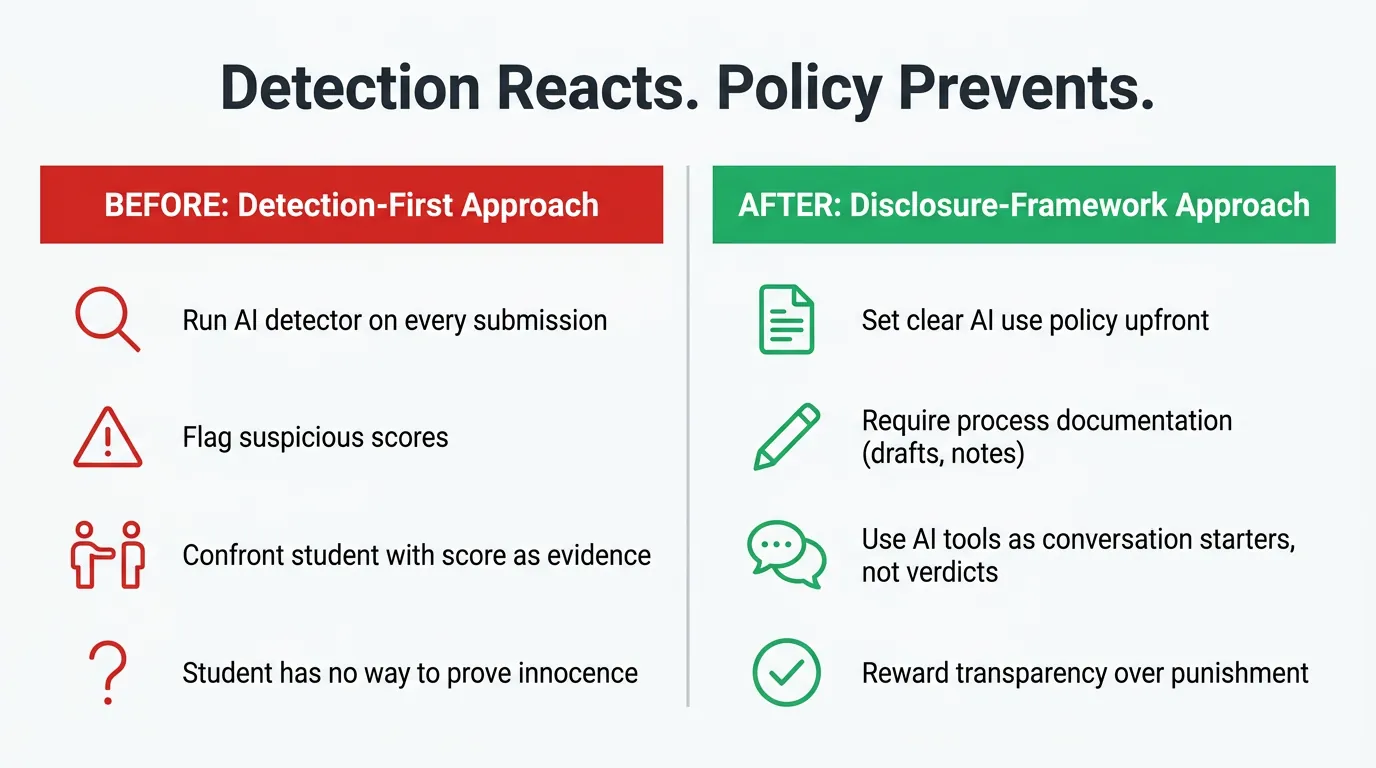

Several universities, including the University of Sydney and Carnegie Mellon, have moved toward transparent AI use disclosure frameworks. Students declare what AI tools they used and how. The conversation shifts from detection to academic integrity. This approach is more defensible, more equitable, and more pedagogically sound. Detection tools cannot tell you whether a student learned anything. Disclosure frameworks can start that conversation.
Clear policy does what no detector can: it sets expectations before work begins.
The institutional energy spent on detection infrastructure would produce better outcomes if redirected toward policy clarity, faculty training, and assessment design.
Where GPTZero Actually Earns Its Reputation
GPTZero has genuine strengths. Dismissing them would undermine any honest assessment.
What GPTZero Does Reliably Well
On unedited output from major models like ChatGPT and Claude, GPTZero’s accuracy runs genuinely high under controlled conditions. Batch processing makes it workable for large-scale content screening workflows where speed outweighs perfect precision. The sentence-level highlighting feature is legitimately useful, directing human attention toward specific passages worth scrutiny rather than delivering only a document-level score.
For a publisher receiving 500 blog submissions weekly, GPTZero as a first-pass filter makes operational sense, and individual false positives are acceptable at that scale when human review follows downstream.
First-pass screening is where GPTZero earns its keep.
The interface has improved meaningfully since 2023. The confidence band display is clearer. The batch upload workflow runs faster. GPTZero’s API integration capabilities make it usable within editorial and LMS systems without manual submission. These are real improvements that reflect genuine product development investment.
The Right Way to Use It as a Signal Not a Sentence
Detection scores should prompt investigation, not immediate accusation. A high GPTZero score is a reason to look closer, nothing more. Corroborating evidence matters: drafts, revision history, in-class writing samples, and direct conversation with the student. The tool is most defensible when treated as a screening layer with human judgment applied downstream, and no detection score alone should initiate formal proceedings. Used this way (as one input among several), GPTZero holds a legitimate place in an educator’s toolkit.
That is a considerably narrower role than most institutions currently assign it.
Practical Guidance for Writers, Students and Publishers in 2026
GPTZero affects three distinct groups differently. The right response depends on which group you’re in.
What Students Should Do When GPTZero Flags Their Work
Build process documentation before you submit anything. Save every draft, every browser tab, every source note. Five minutes of effort creates a defensible paper trail. If your work gets flagged, request a conversation with your instructor rather than disputing the score. Ask them to explain specifically what concerns them about the writing. Come prepared to walk through your process, your sources, and your reasoning out loud. A mixed verdict is not a guilty verdict. It’s an uncertainty signal. You have every right to contest a detection result, and process documentation is your strongest tool for doing so.
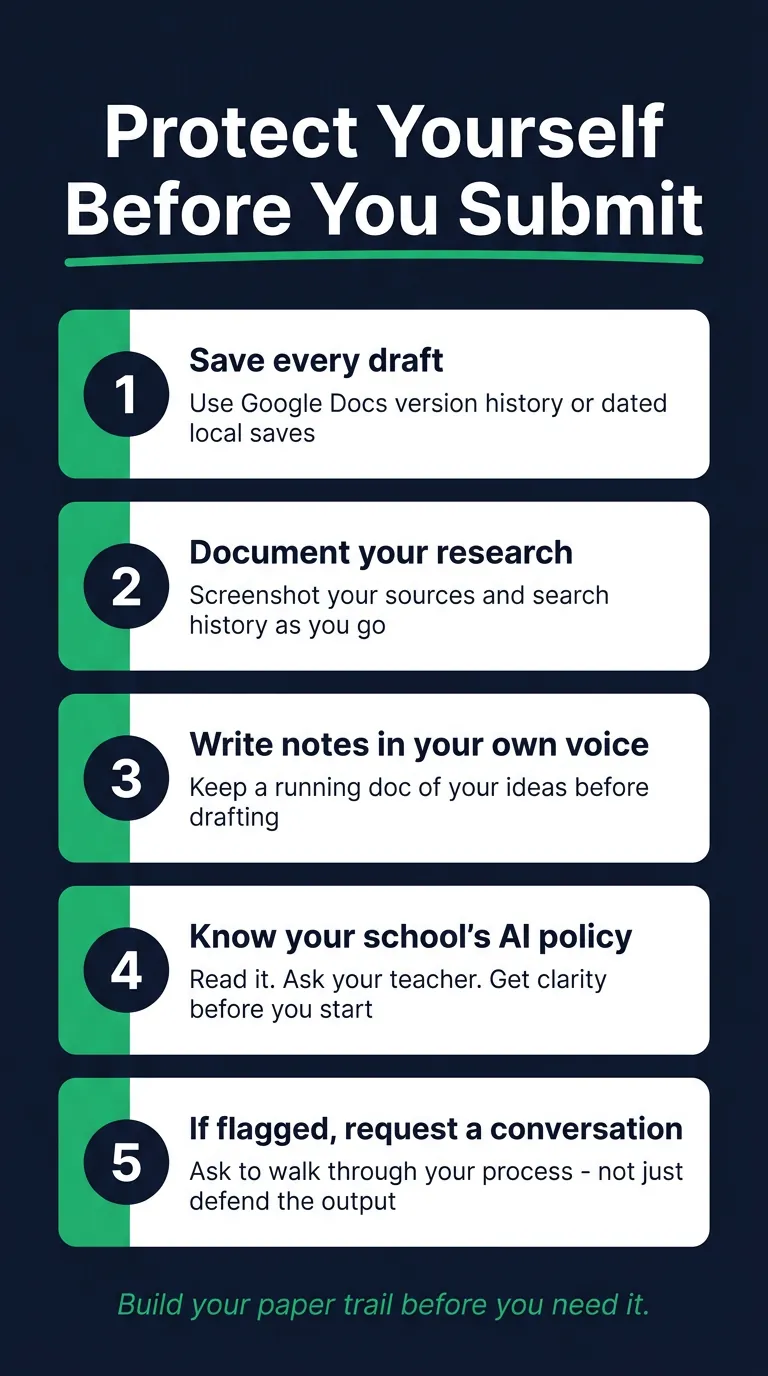

Academic integrity offices are not infallible. Pushing back is legitimate.
A mixed verdict means GPTZero is uncertain. Instructors who treat uncertainty as confirmation need to be challenged directly and respectfully. Know the language: “This result indicates a probability range, not a determination.” If your institution has an ombudsperson or academic appeals process, document everything from the first conversation.
What Writers and Publishers Need to Know About Detection Tools
Publishers using GPTZero as a gatekeeping tool risk rejecting legitimate human-written content on a regular basis. That risk falls hardest on writers who work in formal registers, technical domains, or who are non-native English speakers.
Writers can reduce false positive risk by varying sentence length, mixing formal and conversational register, and steering away from overly consistent paragraph structure. Good writing habits, regardless of detection concerns. For publishers building editorial workflows, GPTZero works best as a triage layer, not a rejection mechanism. A flagged submission deserves human review, not automatic disqualification.
For writers and publishers trying to understand how detection-optimized tools perform in practice, AI BrandFactory’s dedicated comparison resource covers that category in full detail rather than expanding on it here.
The detection tool space shifts faster than any single review can track.
GPTZero is one tool in a growing category, and understanding the full picture requires ongoing attention.
Conclusion
GPTZero is a useful screening tool that has been systematically over-trusted. Its accuracy on unedited AI text is genuine. Its false positive rate on formal, structured, or ESL writing runs too high for enforcement use without corroborating evidence.
No detection score should ever stand alone as proof.
- Students should document their writing process proactively (in 2026, this is basic self-protection).
- Institutions need policy frameworks that set expectations before work begins, not just detection tools deployed after the fact.
- Publishers should treat GPTZero results as a first-pass signal requiring human review. The gptzero ai detector is a useful investigative aid when used within those boundaries.
AI writing detection will keep improving. Policy clarity will always matter more than any tool’s accuracy rate.
Ready to build your brand with AI?
One session. A full month of content. Your brand voice.
Request Private Beta Access →