
AIDA vs PAS: Which Copywriting Framework Actually Works With AI-Generated Copy
AIDA vs PAS: Which Marketing Framework Works Better With AI-Written Copy?
You’ve seen the output. Polished sentences, decent structure, zero conversions. AI-generated copy has a specific failure mode – it looks like marketing but doesn’t act like it.
The problem isn’t the AI.
AIDA and PAS aren’t interchangeable tools – they solve different problems for different audiences. Use the wrong one and even solid AI output will underperform. By the end of this, you’ll have a clear framework decision you can apply to your next prompt immediately.
This isn’t theoretical. I’ve watched the same brief produce wildly different results depending on whether a framework was specified. Pick the right one and AI copy sharpens fast, pick the wrong one and you’re editing forever.
Why Most AI Copy Fails Before It Even Gets to a Framework
Most AI copy problems start at the prompt, not the output. Writers hand AI a brief, skip the structure, and expect persuasion to materialize. It won’t.
What AI Actually Does When You Say “Write Me Marketing Copy”
Without explicit framework guidance, AI blends multiple structures inconsistently. It might open with a hook (AIDA), pivot to a problem statement (PAS), then drift into a feature list with no emotional arc. The result reads fine but converts poorly. AI language models predict the next token based on patterns – and generic marketing copy is the most common pattern in training data. Without a framework label in your prompt, you get an averaged version of everything the model has seen. Framework labeling is the single highest-use fix available. Not better adjectives. Not longer prompts.
Frameworks give AI a scaffold. Without one, you get noise.
Before and After: The Same Brief With and Without a Framework
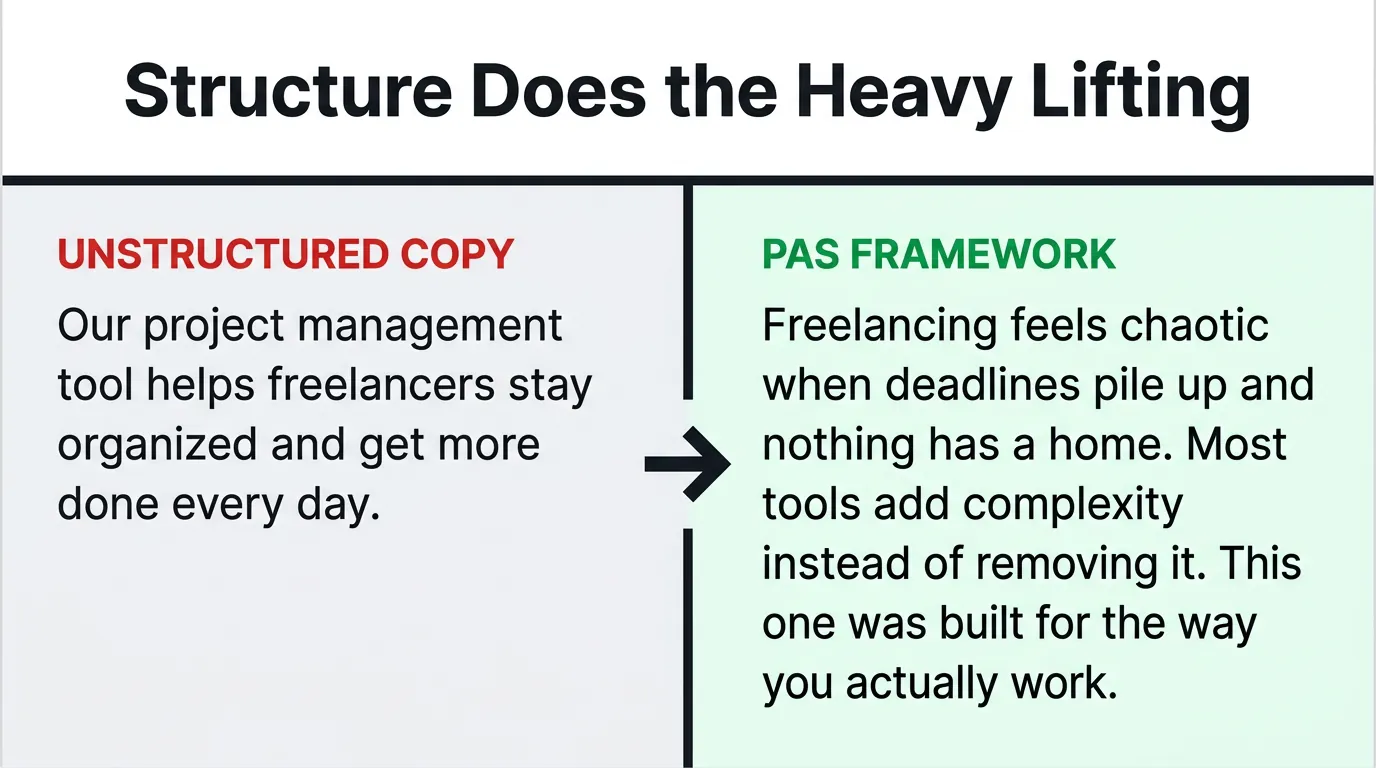
Consider a project management tool targeting freelancers. Unstructured AI output: “Our tool helps you stay organized and productive. Features include task tracking, deadline reminders, and collaboration tools. Try it free today.” Generic tone, no emotional arc, a CTA that could belong to any product on the internet. Now with a PAS framework label: “Freelancing means juggling six clients, three deadlines, and zero backup. One missed task and a relationship cracks. [Product] keeps every project visible, every deadline tracked, every client confident.” The difference is visible in three sentences.
That’s not better writing. That’s structural intent doing the work.

AIDA Does One Job Exceptionally Well and One Job Terribly
AIDA was built for a specific audience condition. Miss that condition and the framework fights you.
The Awareness Problem AIDA Was Built to Solve
Eugene Schwartz mapped customer awareness across five stages inBreakthrough Advertising: unaware, problem-aware, solution-aware, product-aware, and most aware. AIDA targets the unaware-to-solution-aware range – audiences who haven’t fully articulated a desire yet. That’s why it opens with Attention rather than pain. Building desire from scratch requires emotional construction, not just pain validation. AI struggles here without detailed prompting because emotional construction demands specificity – persona, trigger, aspiration – that generic prompts don’t supply.
AIDA in the wrong hands produces aspirational fluff.
Where AI Copy Falls Apart Inside the AIDA Arc
Attention: AI handles hooks reasonably well when given a clear directive and audience context. Interest: this is where AI defaults to feature lists – it describes instead of pulling the reader deeper. Desire: without specific emotional triggers and persona details, AI produces language like “imagine achieving your goals” – technically correct, persuasively useless. Action: AI CTAs are usually competent but often too soft (“Learn more” instead of “Start your free trial today”). AIDA performs best in long-form formats – product pages, sales letters, video scripts – where each stage has room to breathe. Forcing AIDA into a 150-word ad is a structural mismatch, not an AI problem.
Longer formats let AIDA build momentum naturally. Short formats strangle it.
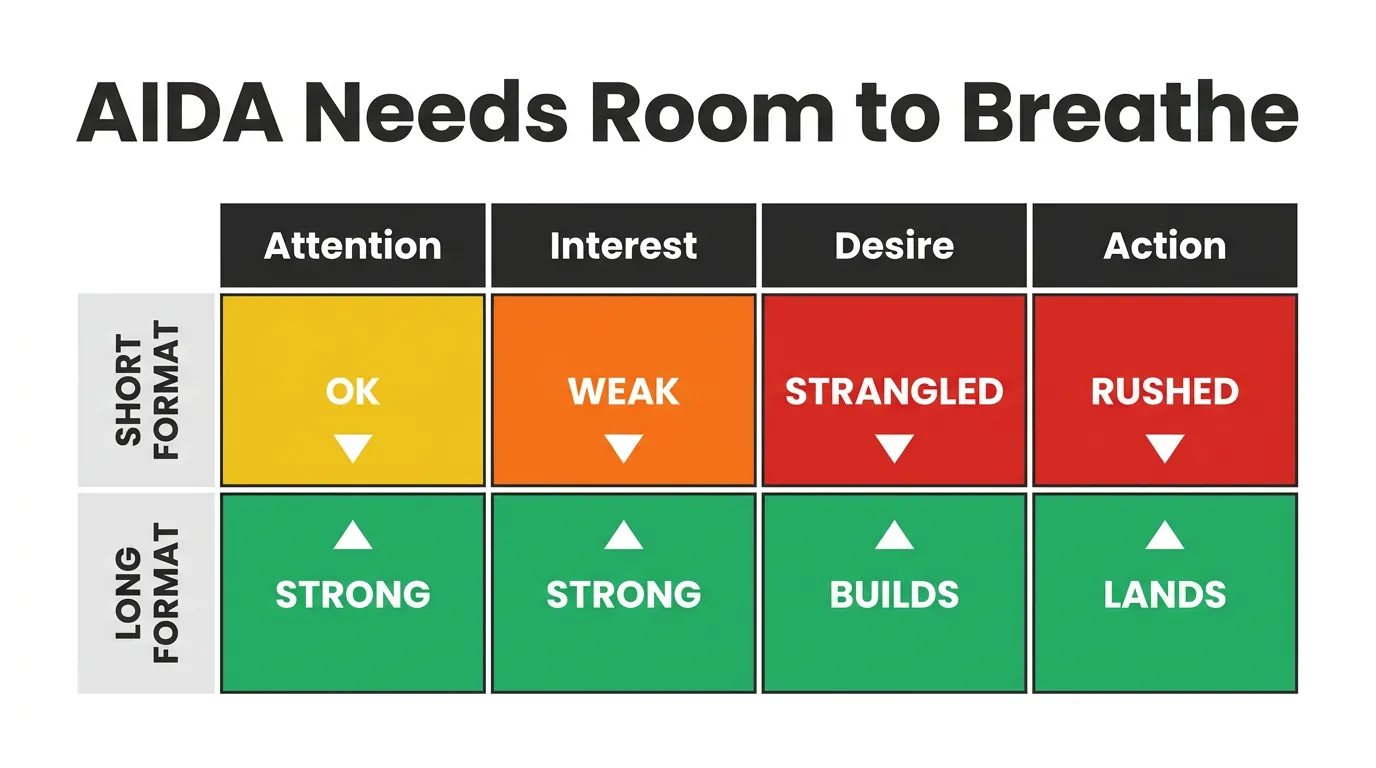

Skeptical that format matters this much? The same AIDA-prompted copy can perform well on a sales page and completely flatline as ad copy – same brief, same AI, different format. Seen it happen.
PAS Is the Framework AI Was Accidentally Built For
PAS and AI are a natural match.
Why the Problem-Agitate-Solution Structure Plays to AI Strengths
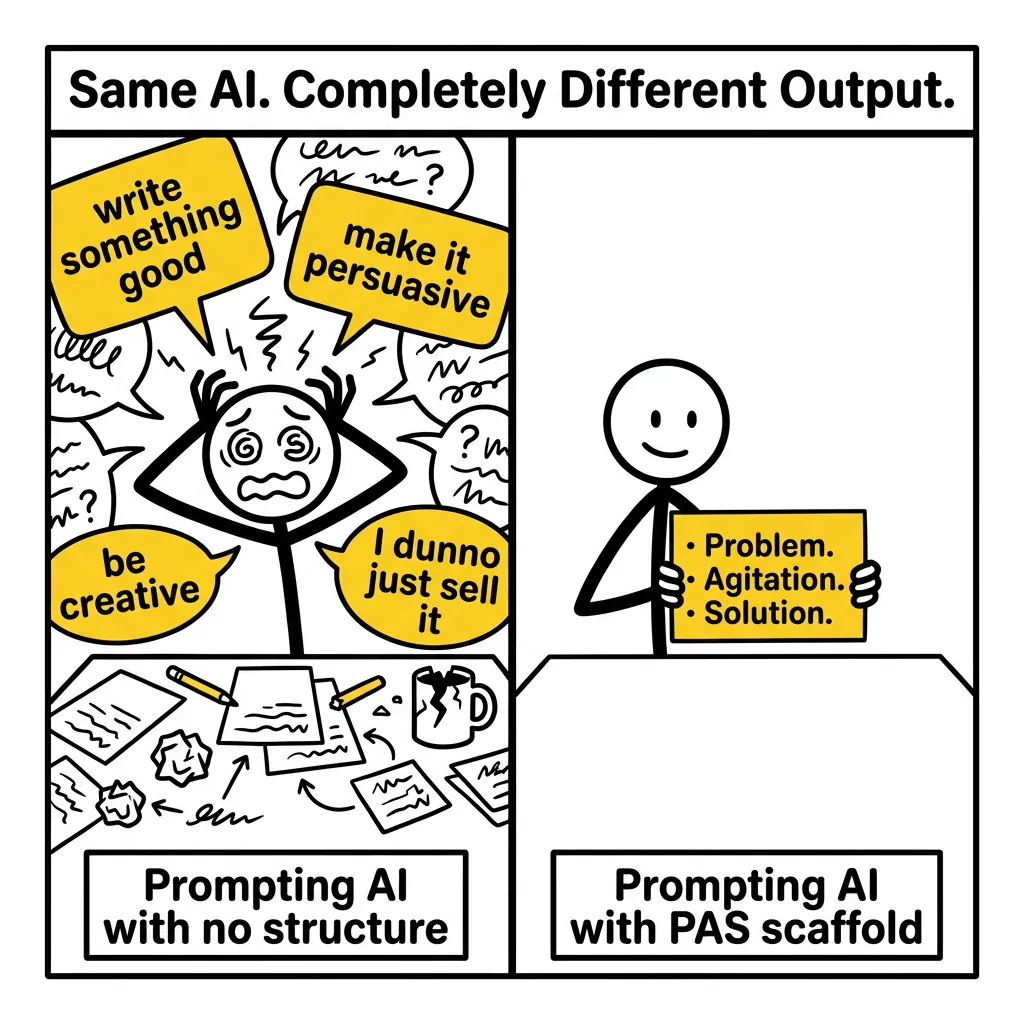
The three-part scaffold is unambiguous at every transition point. Problem stage: AI identifies the pain reliably when given audience context, no emotional construction required. Agitate stage: AI amplifies emotional weight with minimal prompting because intensifying a stated problem is a low-ambiguity task. Solution stage: the logical cue is obvious, AI pivots to the product naturally because the structure demands it. I’ve run the same brief through PAS and unstructured prompts dozens of times. PAS output is consistently tighter, more emotionally resonant, and requires less editing. The three-step scaffold cuts the ambiguity that causes AI to drift. Less drift means fewer revision cycles.
That’s not a small efficiency gain. It compounds across every piece you produce.

PAS front-loads emotional tension. For short-form, that’s a genuine advantage.
Where PAS Wins and Where It Hits a Wall
Email subject lines, ad copy, and landing page headlines, PAS dominates these formats. The problem-first opening creates immediate relevance for problem-aware readers. In long-form content, sustained agitation without relief starts to feel manipulative (admittedly, some direct response writers disagree, but most readers clock it). PAS also falls flat for audiences who don’t yet know they have a problem. If your audience is desire-unaware, leading with pain they haven’t named produces confusion, not urgency. Before/after copywriting examples make this visible fast: a PAS email subject line like “Still losing clients to missed deadlines?” outperforms “Introducing [Product]: Your New Project Manager” by a measurable margin for problem-aware audiences.
The AIDA Remix Is What Actually Works for AI-Generated Copy at Scale
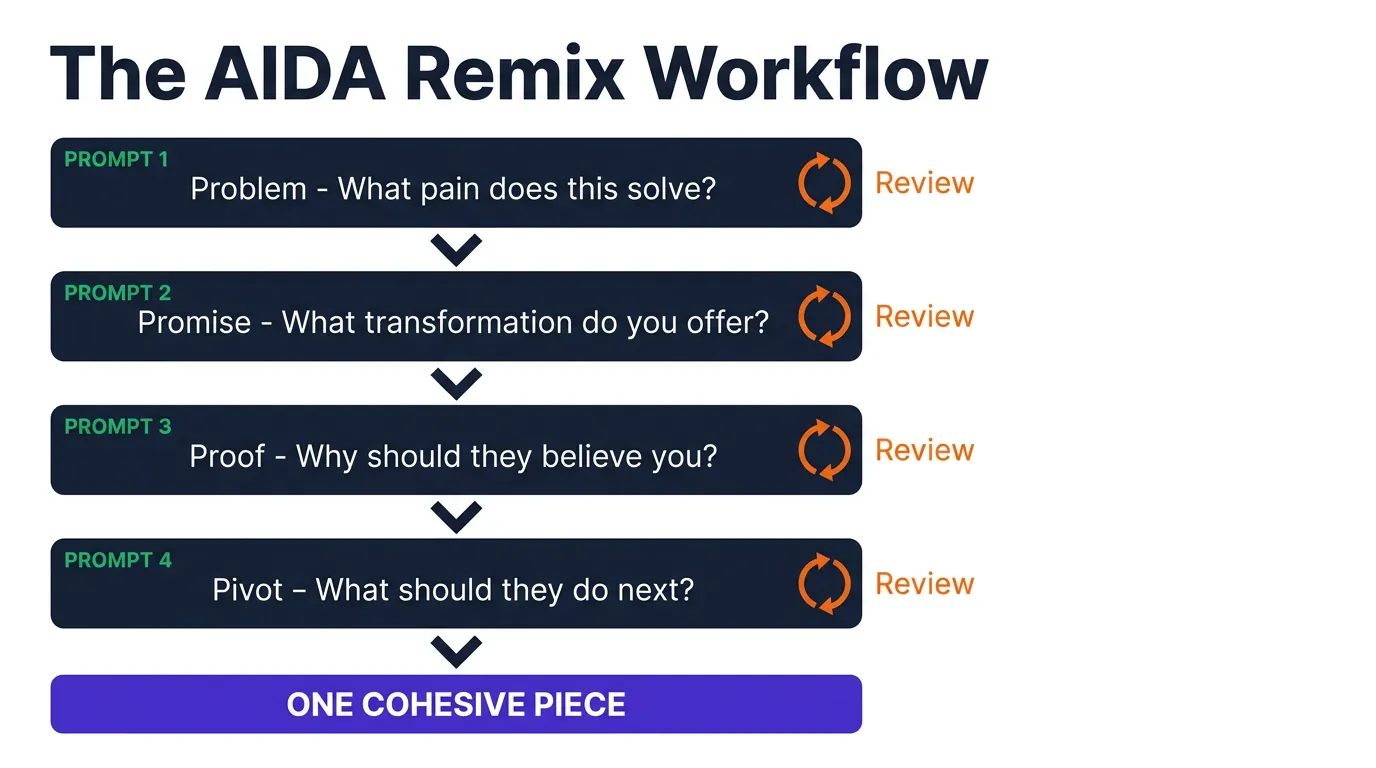
Neither AIDA nor PAS wins cleanly. The AIDA Remix does. Problem, Promise, Proof, Pivot – four stages, four discrete AI tasks, one cohesive piece.
How Problem Promise Proof Pivot Fixes the Weaknesses of Both Frameworks
Problem: opens with pain, exactly like PAS – validates audience frustration immediately without forcing emotional construction from scratch. Promise: makes a bold, specific claim about the outcome – gives AI a clear deliverable with measurable language. Proof: testimonials, data, case studies – AI can generate placeholder proof or slot in real evidence you supply. Pivot: an action-oriented close that feels earned because the first three stages built the case for it. The AIDA Remix doesn’t ask AI to construct desire from nothing (AIDA’s core weakness) or sustain agitation across long-form copy (PAS’s core weakness). Each stage has a clear job. Clear jobs produce clean output.
This is the structural fix most AI content workflows are missing.
Why Modular Prompting Makes the AIDA Remix the Best AI Workflow
Each stage is a standalone AI task – prompt it, review it, refine it independently before assembling. Tonal inconsistencies are a frequent issue in AI-generated content when using single prompts., drops sharply when you break the piece into four discrete prompts. AI BrandFactory embeds framework selection directly into the brief workflow – users specify the AIDA Remix and the platform handles structural scaffolding automatically, so copywriters focus on strategy rather than prompt engineering. Modular assembly also means one weak stage doesn’t contaminate the rest. Fix the Proof section without touching the Promise.
Four prompts, four reviews, one cohesive piece. That’s the workflow.

The Copywriting Examples That Show the Difference in Plain English
Assertions are easy. Examples are evidence.
Same Product, Three Frameworks, Three Completely Different Copy Pieces
Same brief: a time-tracking app for freelancers. Unstructured AI output: “Track your time easily with [Product]. Our intuitive interface makes billing simple. Sign up free.” Blended structure, emotionally flat, weak CTA – it describes the product without addressing the reader’s world. AIDA-guided output: “What if billing took five minutes instead of an hour? [Product] turns scattered time logs into clean invoices automatically. Freelancers using it report getting paid faster and chasing fewer late payments. That’s not a feature – that’s your Friday afternoon back. Start your free trial.” Aspirational arc, builds desire, narrative momentum. PAS-guided output: “Late invoices are killing your cash flow. Every hour of unbilled work is money you earned and never collected. [Product] captures every minute automatically – no spreadsheets, no guessing, no unpaid work.” Immediate tension, urgency-forward, action-driving.
Each version targets a different awareness entry point. Each one is structurally intentional.
The AIDA Remix Version and Why It Outperforms Both
Same brief, AIDA Remix treatment: “Freelancers lose an average of six billable hours per month to tracking gaps [Problem]. [Product] captures every minute automatically and generates your invoice in one click [Promise]. Over 4,000 freelancers recovered their first lost hour within a week of signing up [Proof]. Start your free trial – your next invoice is already waiting [Pivot].” Emotionally grounded and aspirationally directed, it covers both awareness entry points at once. The structure runs tighter than standard AIDA and avoids the relentlessness that PAS accumulates across multiple paragraphs. The Pivot lands because Problem, Promise, and Proof did the groundwork first. Put them side by side and the superiority isn’t something anyone needs to claim. It’s just visible.
That’s what good copywriting examples actually do. They show the work.
How to Choose the Right Framework for Your Product and Audience Right Now
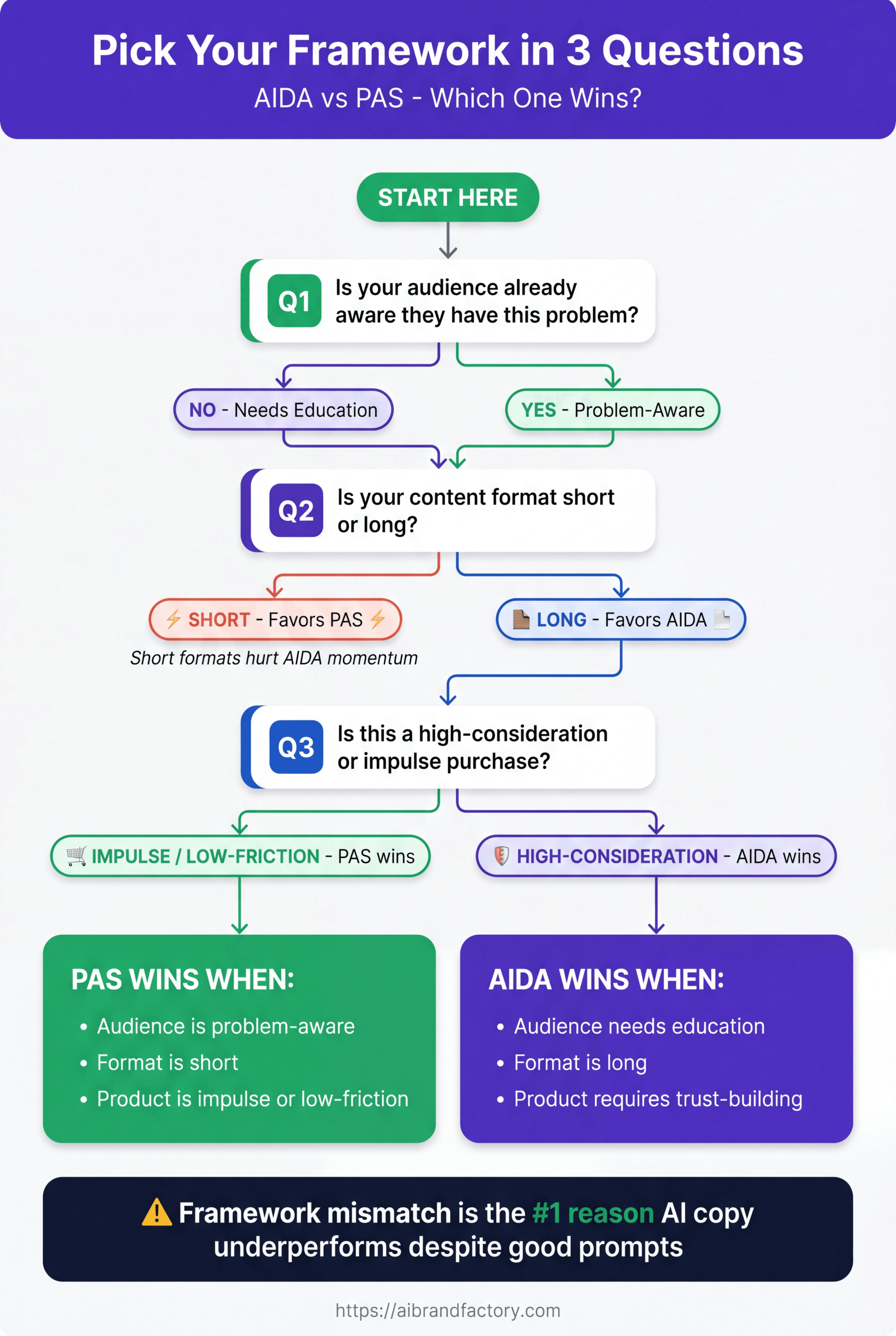
Framework choice comes down to three questions. Answer them before you open a prompt. Get them wrong and no framework rescues the output.
The Three Questions That Determine Your Framework Every Time
Question one: is your audience problem-aware or desire-unaware? Problem-aware audiences respond to PAS because it confirms existing frustration. Desire-unaware audiences need AIDA’s aspirational construction first. Question two: short-form or long-form? PAS for email, ads, and headlines – AIDA or the Remix for product pages, sales letters, and scripts. Question three: pain-driven product or aspirational product? Pain-driven maps to PAS. Aspirational maps to AIDA or the Remix. Schwartz’s awareness spectrum is the underlying logic for all three questions – it was built for this exact decision.
No quiz needed. Three questions, honest answers, clear framework.

When None of These Frameworks Will Save Bad Copy
Frameworks break down when the product benefit is unclear or the audience is undefined. AI BrandFactory removes the prompt engineering burden by embedding framework selection into the brief – but even that tool can’t fix a vague value proposition or an undefined target reader. Prompt specificity – persona, emotional triggers, differentiators – matters as much as framework choice. No tool replaces strategic clarity about who you’re writing for and why they should care.
Pick the framework second. Know the audience first.
Conclusion
PAS fits problem-aware audiences and short-form content. AIDA suits aspirational products with enough space to build a narrative. The AIDA Remix handles AI-generated copy at scale because its four discrete stages map cleanly to four manageable AI tasks.
When uncertain, default to the AIDA Remix.
Tag your next AI prompt with a framework – any of the three. Then compare that output against your last unstructured generation.
The difference will settle it for you.
Ready to build your brand with AI?
One session. A full month of content. Your brand voice.
Request Private Beta Access →