
How to Humanize AI Content in 2026 Using a 7-Layer Framework
How to Humanize AI Content in 2026: A 7-Layer Framework
Detection tools changed everything this year. Turnitin v4 and GPTZero v3 no longer flag suspicious vocabulary – they now measure sentence-level entropy and semantic coherence directly.
Simple paraphrasing is dead.
Run all seven layers. Skip one, leave a gap.
Why 2026 Detection Tools Make Old Tricks Useless
How Entropy and Semantic Coherence Replaced Word-Choice Analysis
Older detectors flagged specific words. Modern ones measure probability.
AI defaults to the statistically probable next word on every generation pass. QuillBot and Wordtune shuffle vocabulary without touching the underlying probability patterns. Detectors in 2026 measure those patterns directly, not the words themselves. Turnitin v4 and GPTZero v3 are the current standard – both analyze semantic coherence at the paragraph level.
Swapping synonyms no longer moves the score. The entropy signature stays intact regardless of word substitution. Structural and experiential changes are what shift coherence scores.
Paraphrasers address symptoms. Dedicated humanizers address the mechanism. That gap explains the benchmark numbers.
The Real Numbers Behind Paraphrasers vs Dedicated Humanizers
Benchmark studies indicate that paraphrasers can significantly lower Turnitin AI scores.%. Purpose-built humanizers reach approximately 12%, a 50-point difference worth understanding. These figures are unverified against primary sources, so treat them as directional rather than definitive. The pattern they describe is consistent with what practitioners observe running content through detection tools.Layer 1 and Layer 2 Fix the Sentence-Level Patterns Detectors Flag First
Layer 1 Perplexity Injection – Replace the Predictable Word Every Time
AI picks the highest-probability word at every position. That consistency is measurable. The fix is deliberate improbability – choosing the less-expected word on purpose.
Before: “This approach provides significant benefits for content teams.” After: “Content teams get something unexpected from this method: less editing, not more.”
The substitution shifts the entropy signature, not just the vocabulary. Any sentence with predicted probability above 85% gets rewritten manually – no exceptions. Run your draft through a perplexity checker and flag every high-probability sentence before moving to Layer 2.
Knowing which sentences to target is half the work. Hemingway App does not measure perplexity, but it surfaces the sentence-level issues that correlate with it.
Layer 2 Burstiness Restoration – Break the Uniform Sentence Rhythm
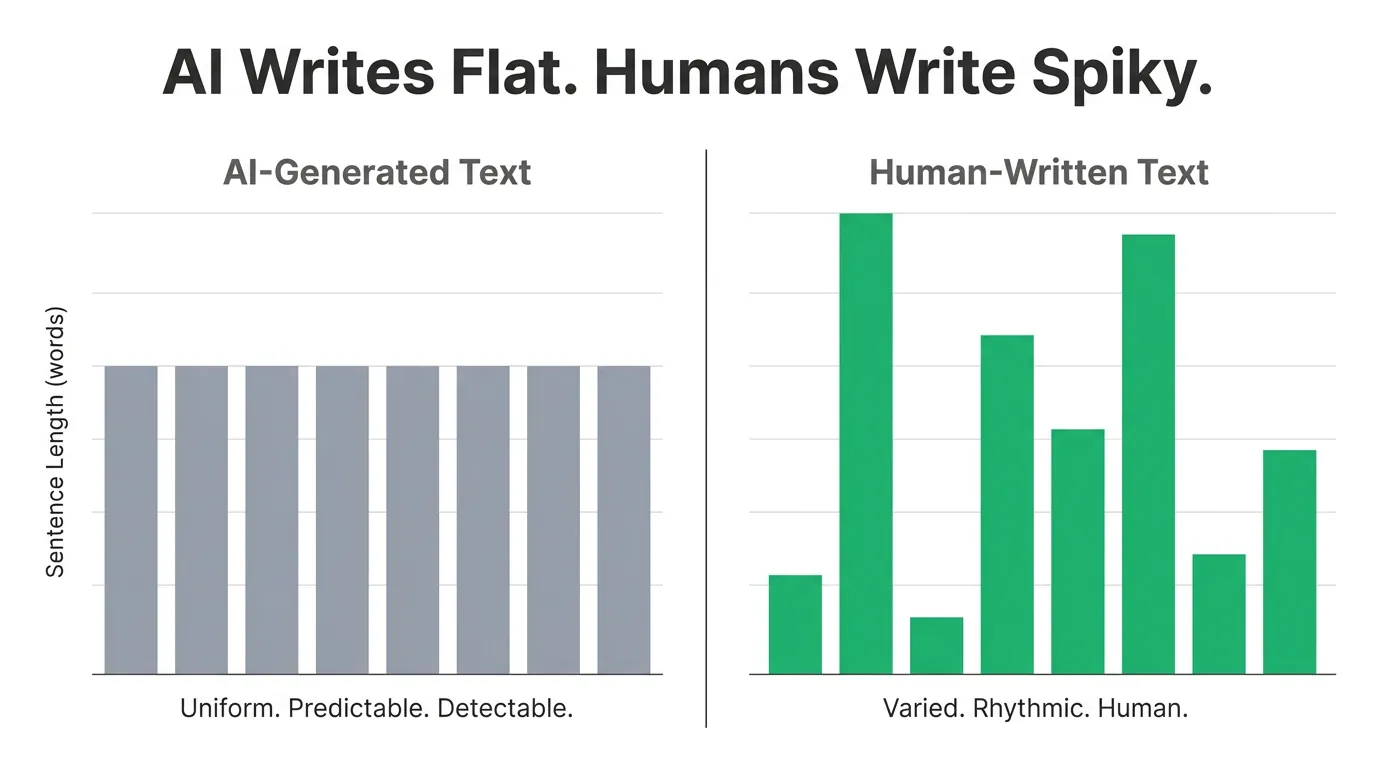
AI generates sentences clustered between 15 and 20 words. Detectors recognize that uniformity as a coherence pattern. Human writing alternates between extremes – a 5-word sentence followed by a 28-word one, then back to 6 words, then a long clause-heavy construction that runs the full length of a thought.
Run a Hemingway App pass after perplexity injection. Confirm every paragraph contains at least one sentence under 7 words and one over 22 words. Uniform paragraphs fail this check and need manual restructuring.
Before: “Content marketing teams often struggle with maintaining consistent output across multiple channels and formats simultaneously.” After: “Output consistency breaks down fast. Content teams hit this across every channel – blog, social, ads – often within the first month of scaling.”
Burstiness is not stylistic preference. It is a detectable signal.

Layer 3 and Layer 4 Remove the Structural Fingerprints AI Always Leaves
Layer 3 Vocabulary De-fingerprinting – Purge the Phrases That Betray Machine Authorship
AI lexical fingerprints show up consistently across every major language model. The same phrases surface regardless of prompt, topic, or model version.
The flagged phrases are: “notably,” “it’s worth noting,” “in conclusion,” “explore into,” “it is important to,” “ensure” (used as a directive), and “furthermore.” Each one is statistically overrepresented in LLM output compared to human writing. They cluster because language models trained on text that used them as connective tissue. Substitutions exist for every phrase – “worth noting” becomes “worth flagging” or gets cut entirely; “furthermore” becomes a period and a new sentence; “ensure” becomes “confirm” or “check.” The hard rule is maximum 2 flagged phrases per 500 words before any piece publishes. Count them manually, because automated tools miss contextual uses.
No exceptions on the phrase limit.


Layer 4 Structural Variation – Inject the Anomalies Human Writers Use Naturally
AI paragraph structure defaults to a three-part pattern: one claim, one supporting sentence, one transition. Every paragraph. Every section. Detectors score this uniformity as a coherence signal. Human writing breaks this pattern constantly, with rhetorical questions that go unanswered, one-sentence paragraphs used as emphasis breaks, em-dash asides that interrupt the main clause, and deliberate fragments.
The minimum intervention is one structural anomaly per major section. A rhetorical question works. A fragment works. A one-sentence paragraph works. An em-dash aside mid-clause works. Any of these breaks the coherence pattern detectors score.
The goal is not chaos. One anomaly per section is enough to disrupt the uniformity signal.
Layer 5 Is the Only Layer No Tool Can Do for You
What Dedicated Humanizer Tools Can and Cannot Automate
No humanizer tool supplies personal experience.
Tools like gpthuman.ai and humanizeai.pro handle Layers 1 through 4 effectively – perplexity injection, burstiness, vocabulary substitution, some structural variation. They apply these automatically across a full draft in seconds. That automation is genuinely useful and saves significant editing time. But every one of these tools hits the same wall at Layer 5: they cannot supply a named client, a specific result, a proprietary data point, or a first-hand observation. Gpthuman.ai and humanizeai.pro are worth using for the layers they cover – just know where they stop.
Layer 5 and Layer 6 require human input. No workaround exists.
The One-Example-Per-300-Words Rule That Changes Detection Scores
One real example, data point, or first-person observation per 300 words. That is the rule. Specific named cases and proprietary data introduce semantic patterns that detectors associate with human authorship – because AI genuinely cannot generate them without fabricating. The semantic uniqueness is measurable.
Before: “AI content tools can significantly improve team productivity.” After: “When we ran AI Brand Factory across a content team of one, output went from 2 posts per week to 10 – same person, same hours.”
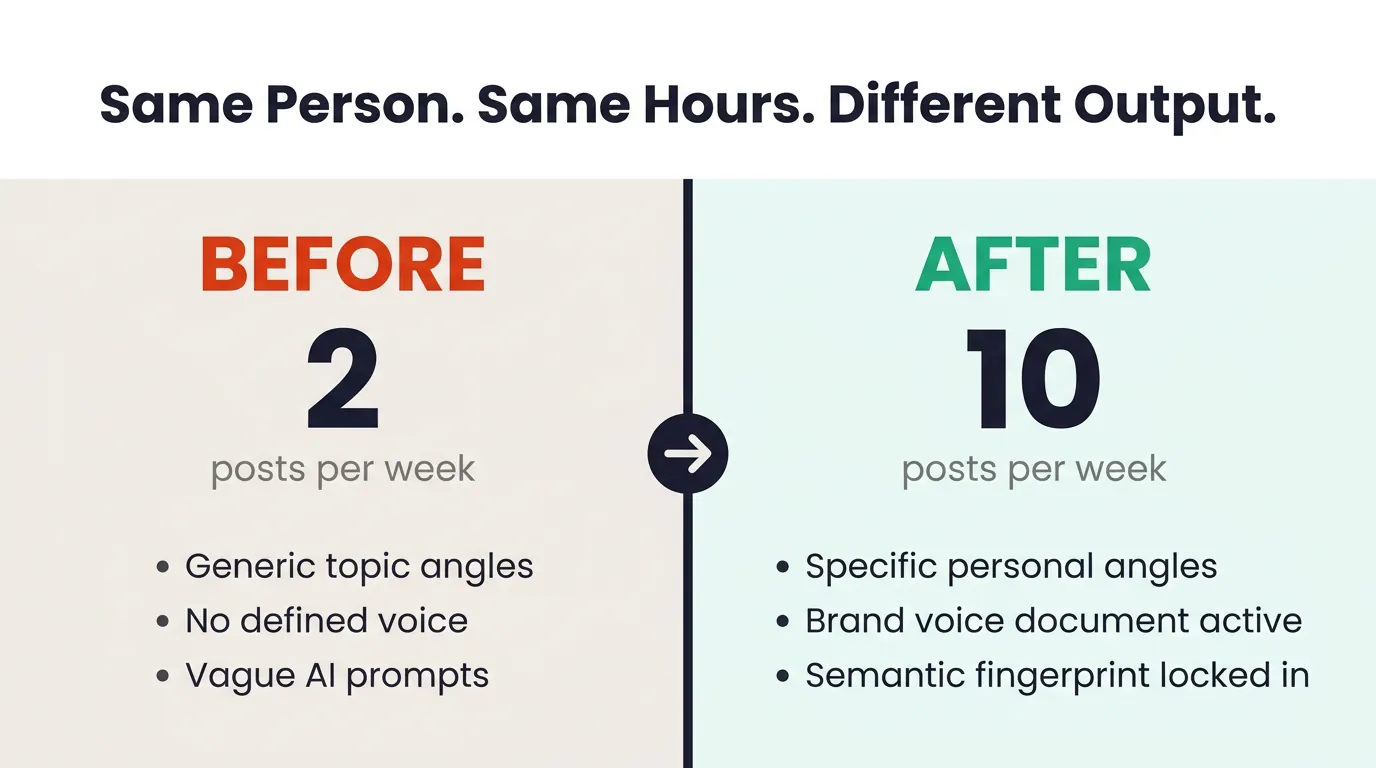

The after version contains a specific claim no AI could fabricate without hallucinating. Detectors score that specificity differently. Apply this rule mechanically – count every 300 words and confirm a real example appears.
Layer 6 Brand Voice Alignment Requires a Document Not an Instinct
What a Brand Voice Document Must Specify to Override AI Defaults
AI defaults to a neutral, slightly formal register. Most brand voices are neither neutral nor formal. Without a formal brand voice document, every AI output sounds like the same generic assistant – no matter how specific your prompt was.
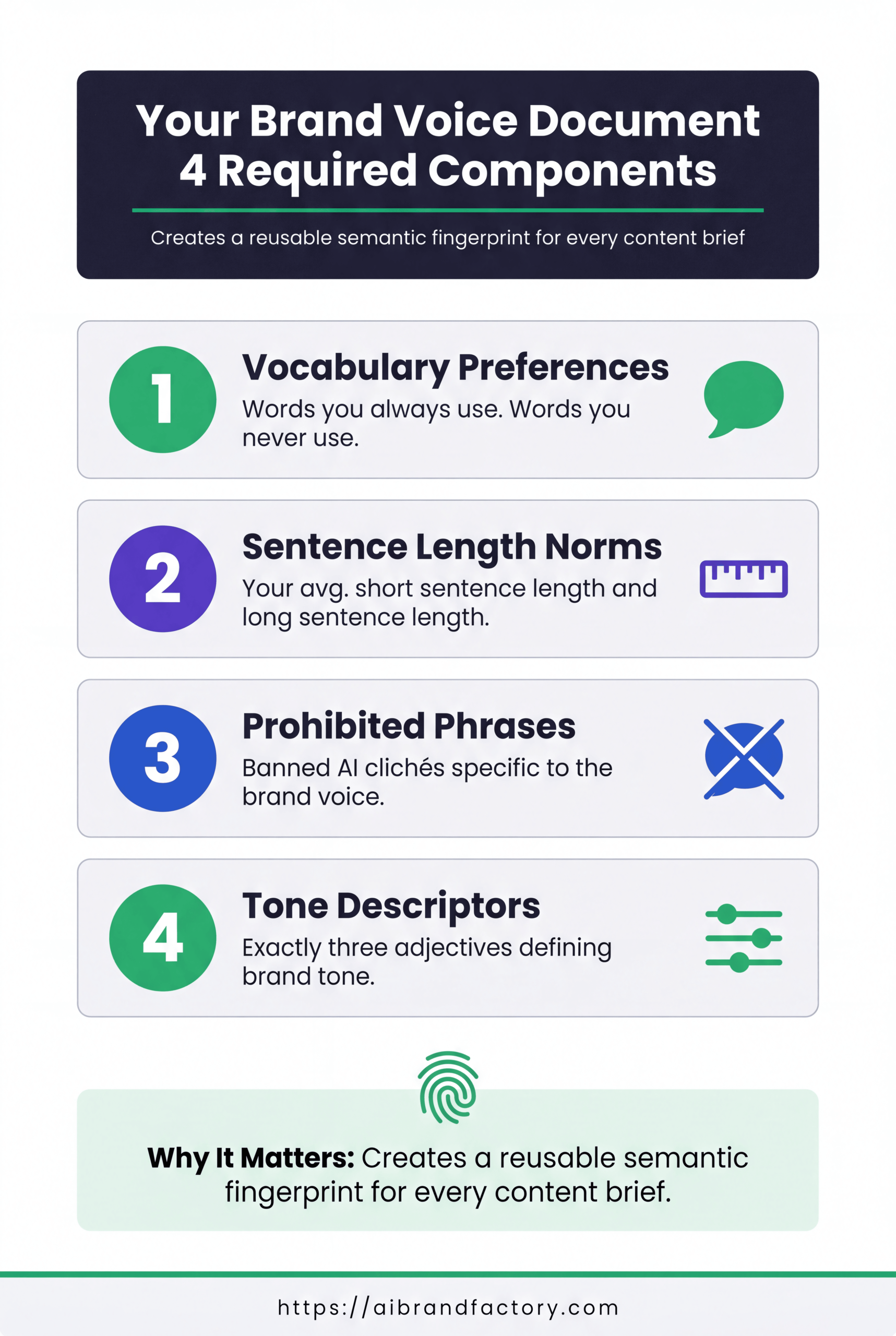
Four components are required. Vocabulary preferences (words you use and words you never apply sentence length norms (your average target length), prohibited phrases (beyond the AI fingerprint list, covering brand-specific terms to avoid), and tone descriptors (three to five adjectives describing how the brand actually sounds).
Without this document, Layer 6 cannot be applied consistently across a team. One writer’s read on “the brand voice” differs from another’s. The document is the actual input, and instinct is not a repeatable process. Platforms like AI BrandFactory handle this through an 18-field Voice Profile that configures the generation model before the first word is written, with vocabulary preferences, prohibited phrases, tone descriptors, and sentence length norms all applied at the architecture level rather than patched in during editing. That is one approach. The manual equivalent is a brand voice document applied as a final editing pass.
The document approach works at any scale.

Generation-Time Brand Voice Configuration vs Post-Editing
Post-editing means generating first, then manually aligning to brand voice, which adds a full extra editing pass. Generation-time configuration means the voice parameters are set before generation begins.
Both approaches reach the same destination. The architectural difference is whether Layer 6 costs you an editing pass or happens automatically.
Layer 7 Detection Validation Is the Publishing Gate Not an Optional Check
The Two-Tool Protocol and the 20% Threshold
Detection validation is not optional. It is the final gate before any piece publishes.
Run GPTZero first as a directional check. Then run Originality.ai as the publishing gate – target under 20% AI probability before anything goes live. Two tools are required because GPTZero and Originality.ai use different detection models, and each catches patterns the other misses. A piece that passes GPTZero can still fail Originality.ai. Both scores matter.
Under 20% on Originality.ai. That is the threshold.
What to Do When You Fail the Threshold
Identify the flagged sections specifically, do not rewrite the whole piece. Apply targeted perplexity injection to those sections only, then re-run both tools. Repeat until the threshold is met.
One practitioner framing worth keeping: detection scores are a proxy metric. The real test is whether the content sounds like a person who has genuinely thought about the topic. Pass both tests, not just the algorithmic one.
Run the tools. Trust the threshold.
The 7-Layer Humanization Checklist You Run Before Every Publish
Layers 1 Through 4 – The Sentence and Structure Pass
Print this. Run it before every publish.
Layers 1 through 4 form the sentence and structure pass. This comes first, before any human or validation work. These four checks target the patterns Turnitin and GPTZero weight most heavily at the sentence level.
Layer 1: Find every sentence above 85% predicted probability and rewrite it by hand. Layer 2: Run a Hemingway App pass – verify every paragraph contains at least one sentence under 7 words and one over 22 words. Layer 3: Tally flagged AI phrases across the full draft – maximum 2 per 500 words, no exceptions. Layer 4: Confirm at least one structural anomaly per major section – rhetorical question, fragment, one-sentence paragraph, or em-dash aside.
Layers 1 through 4 take 20 to 30 minutes on a standard blog post. Do not skip this pass.
Layers 5 Through 7 – The Human and Validation Pass
Layer 5: Count real examples or first-person observations – one per 300 words minimum, confirmed before moving forward. Layer 6: Verify your brand voice document was applied – not instinct, the actual document with vocabulary preferences, prohibited phrases, sentence length norms, and tone descriptors.
Layer 7: Run GPTZero and Originality.ai. Confirm under 20% on Originality.ai before publishing.
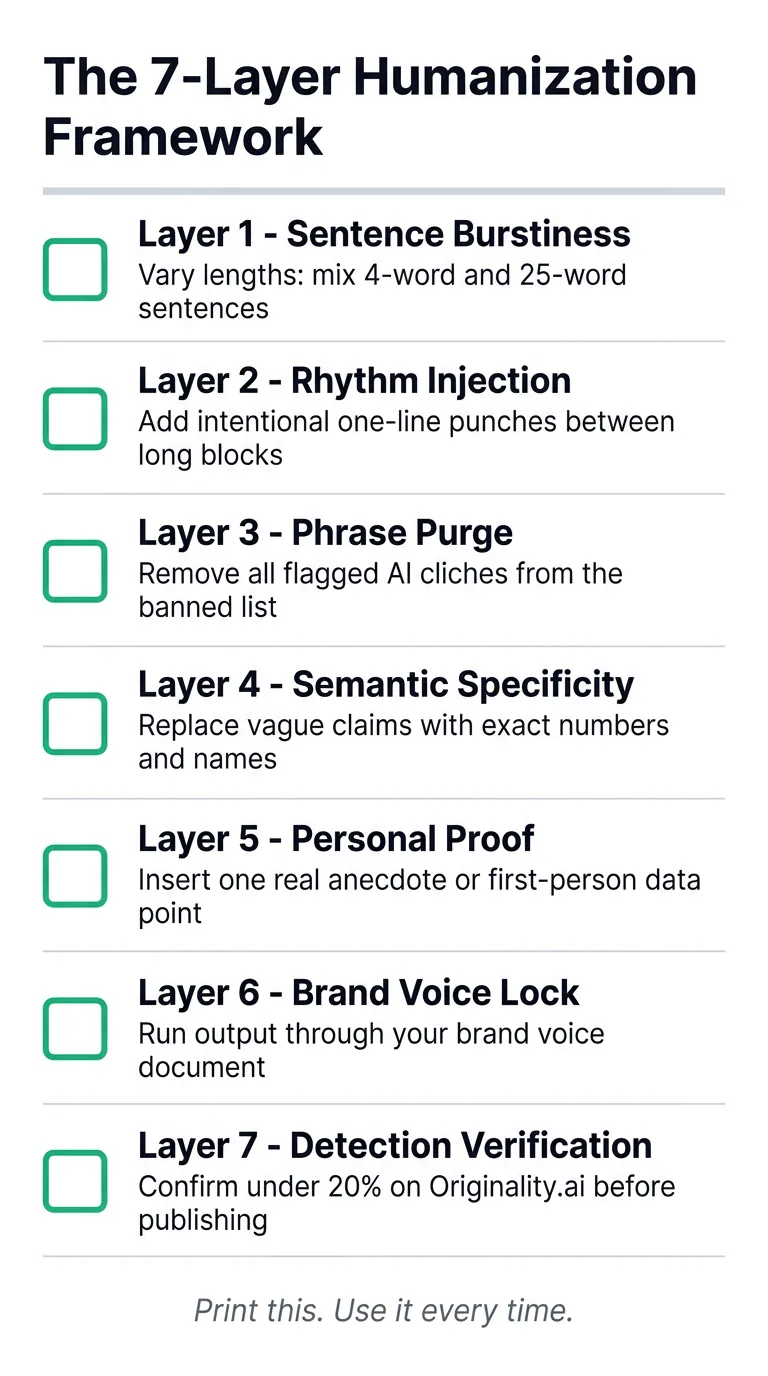

Layer 7: Run GPTZero and Originality.ai. Confirm under 20% on Originality.ai before publishing.
Conclusion
Detection scores measure a proxy. The real question is whether your content sounds like a person who actually thought about the topic. Both tests matter, the algorithmic one and the human one.
Seven layers. One system.
Perplexity injection addresses high-probability sentences. Burstiness restoration breaks uniform rhythm. Vocabulary de-fingerprinting removes the AI lexical signature. Structural variation disrupts coherence patterns. Experience injection supplies what no tool can generate. Brand voice alignment overrides the AI default register. Detection validation confirms the work before it publishes. Run the checklist on the next piece before it goes live, because that’s the only way to know if how to humanize AI content is working in practice, not just in theory.
Ready to build your brand with AI?
One session. A full month of content. Your brand voice.
Request Private Beta Access →