
How to Use AI to Write Content That Actually Sounds Human and Ranks in 2026
How to Use AI to Write Content That Sounds Human and Ranks
Your AI content sounds like AI content. You already know this. The question is what to do about it.
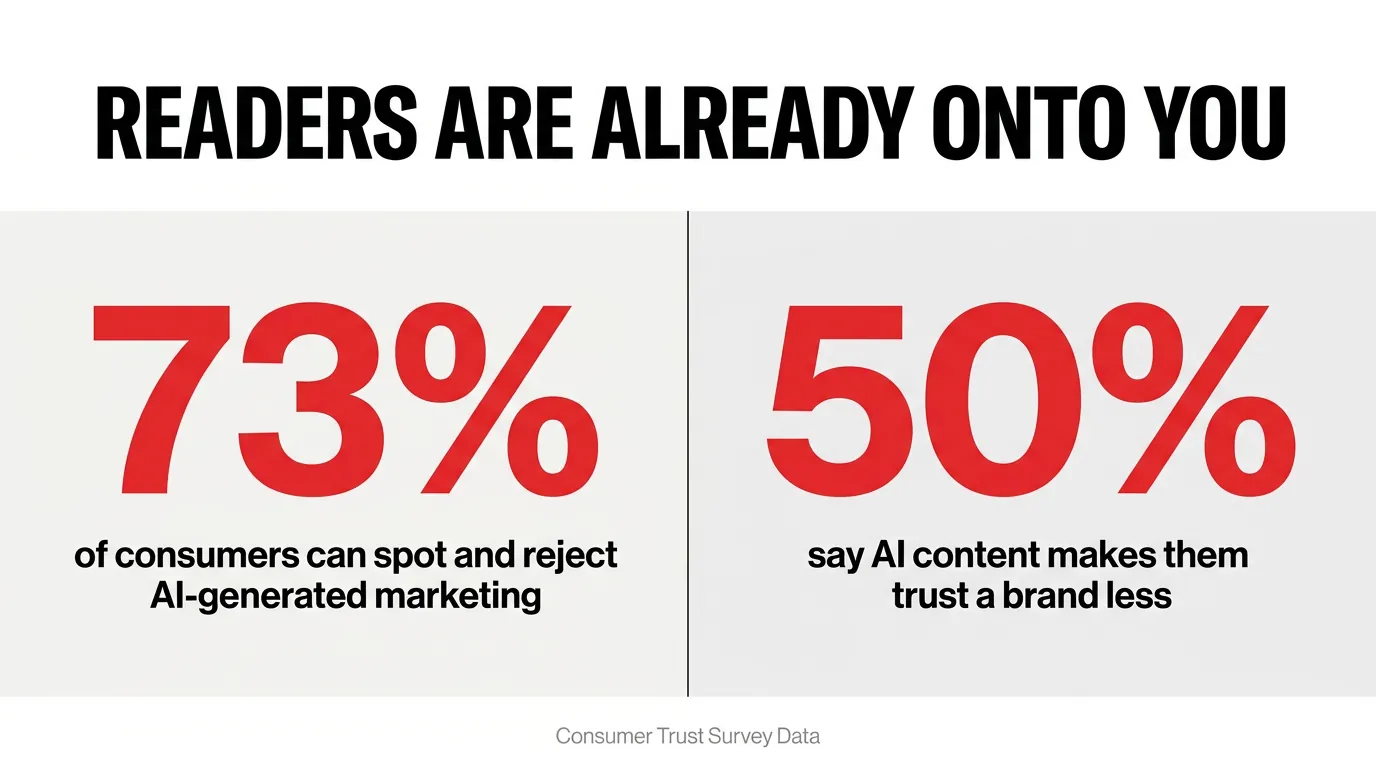
According to humanizeai.com, 73% of consumers report they can spot and reject AI-generated marketing. That number should stop you cold. You’re using AI to write content, but readers are bailing before they finish the first paragraph. The tool isn’t the problem. The workflow around it is. Better prompts produce better AI content – not human content.

A 5-stage humanization system fixes this.
This article walks through every stage. You’ll get a before/after paragraph transformation showing exact edits. You’ll get a pre-publish checklist you can use immediately. The system works for blog posts, LinkedIn posts, and social content.
Stop adjusting prompts. Start building the workflow that makes AI content rank.
Why 82% of Readers Already Know Your Content Was Written by AI
The Detection Numbers Nobody Wants to See
Detection isn’t a technical problem (A research center claims that more th…). It’s a reader trust problem.
According to humanizeai.com, 73% of consumers report they can spot and reject AI-generated marketing. That’s not a minority. That’s your audience, actively filtering your content out before it gets a chance to convert. A separate roboticmarketer.com report found that 50% can correctly identify AI-generated copy in a direct comparison test. These aren’t edge cases. These are your actual readers making real-time trust decisions about your brand.
A recent study indicates that a large majority of Americans believe they can recognize AI-generated content.. That figure from roboticmarketer.com deserves a moment. Four out of five readers approach your content carrying built-in skepticism, not curiosity. They’re not reading to engage – they’re reading to confirm a suspicion. Detection kicks in before the second paragraph. By the third, they’ve already decided whether to trust you or click away. Flat sentence rhythm gives it away first, then come the hedge words, then the absence of anything specific, personal, or verifiable.This is a conversion problem, not a stylistic preference.
What Readers Actually Do When They Spot AI Content
Bounce rates climb when content feels generic. Readers don’t email you to say the writing felt robotic. They just leave.
Brand trust erodes quietly. Readers who sense AI-generated writing feel talked at, not talked to. That gap kills repeat visits, email signups, and sales conversations before they ever begin.
Google’s quality signals pick up on the same patterns readers reject. Thin authority signals, absent attribution, and symmetric sentence structures all factor into how content gets evaluated. The reader and the algorithm are, in this case, looking for identical evidence: proof that a real person with real knowledge wrote this.
Why Better Prompts Will Not Save Your AI Content in 2026
The Prompt Engineering Ceiling Everyone Hits
Every prompt engineer runs into the same wall eventually. Better prompts produce cleaner AI content, but it’s still AI content. The structure stays symmetric. The vocabulary stays safe. The voice stays flat.
“Using AI to write content and using AI to write content that sounds human are two entirely different disciplines,” goes one of the more candid observations circulating in content circles right now. “The second one is a system, not a shortcut.” Prompts control what AI writes. They don’t control how human it sounds.
AI generates from training data patterns, not from your style guide, your opinions, or your specific experience. The ceiling is structural. AI defaults to symmetric sentence lengths, hedge phrases like “it’s worth noting,” and transitions like “furthermore” because those patterns dominate its training corpus. You can instruct AI to avoid them. It still gravitates toward them. That’s the ceiling.
Prompt engineering is not the answer.
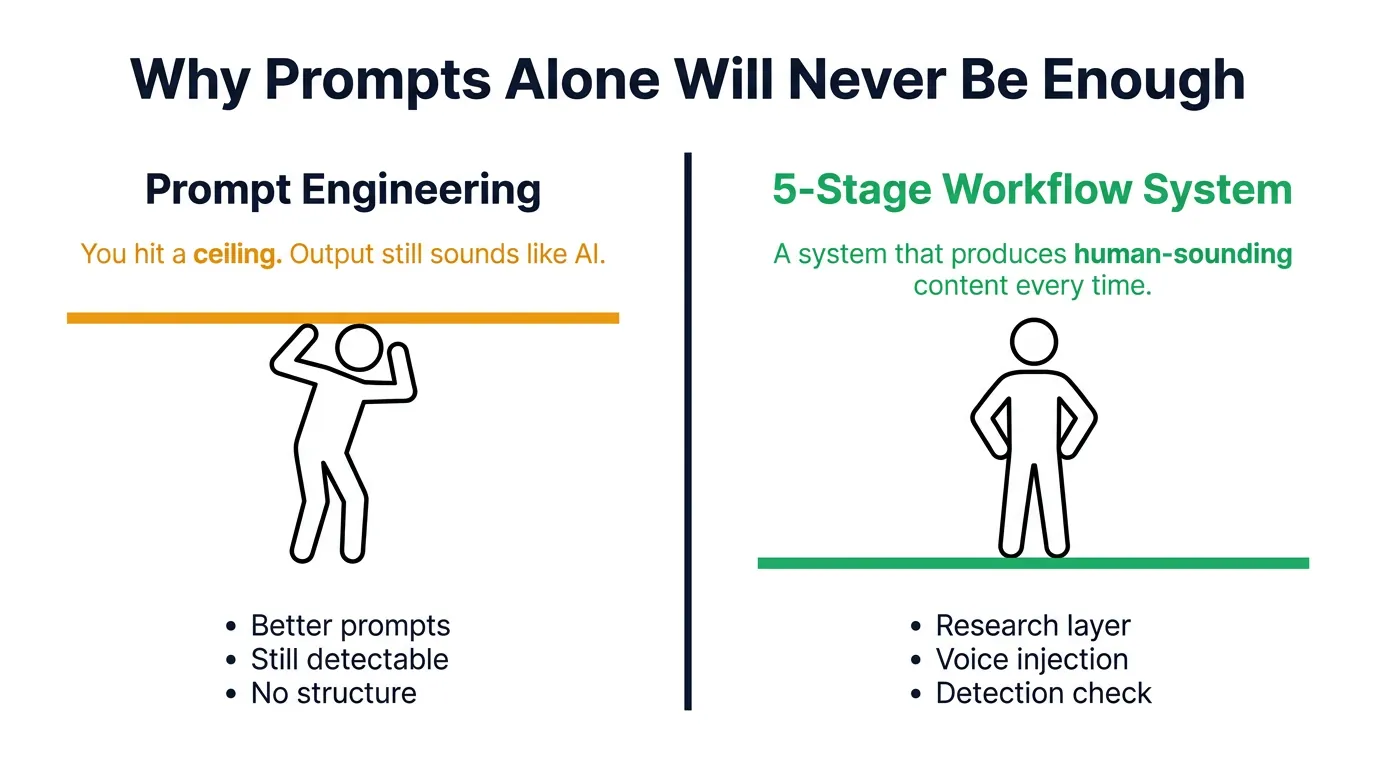

You can spend weeks refining your prompt library and still produce content that reads as AI-generated by the first paragraph. The structural patterns are baked into how the model generates, not into what you ask it to do. Sophisticated prompts narrow the gap. They don’t close it.
The gap closes with a system.
What the Best AI Content Brands Do Differently
Authentic experience is what AI cannot supply on its own, as foundera.co puts it directly. Exact metrics, named case studies, first-person anecdotes, AI cannot fabricate these convincingly. Readers and algorithms both notice when they’re absent. The system makes sure they’re always present.
Authentic experience is what AI cannot supply on its own, as foundera.co puts it directly. Exact metrics, named case studies, first-person anecdotes, AI cannot fabricate these convincingly. Readers and algorithms both notice when they’re absent. The system makes sure they’re always present.
The workflow covered below operationalizes that separation. Five stages. Each one discrete. Each one fixable when it breaks.
How Google’s E-E-A-T Framework Punishes Raw AI Output
What E-E-A-T Actually Requires from Your Content
Google’s E-E-A-T framework (Experience, Expertise, Authoritativeness, Trust) isn’t a checklist. Quality reviewers use it as a lens to judge whether content came from someone who genuinely knows their subject.
- Experience demands first-hand evidence. Not “many businesses find that…” but “our bounce rate dropped 34% after we changed the H1 (New study uncovers why some people le…).”
- Expertise means demonstrated depth, subject matter knowledge that goes well past pattern completion.
- Authoritativeness requires credible attribution: named sources, cited studies, verifiable claims from real institutions.
- Trust means every statistic links somewhere real and every assertion can be checked.
All four dimensions are non-negotiable if ranking matters to you.
The Specific Ways AI Content Fails Quality Reviewers
- Unattributed statistics fail the Trust dimension immediately. “Studies show that…” with no source is a red flag to any quality reviewer, human or algorithmic.
- Symmetric sentence rhythm and hedge vocabulary signal low Expertise. When every sentence runs to roughly the same length and every claim gets softened with “essentially” or “notably,” the content reads as pattern-generated rather than knowledge-driven.
- Missing named sources and case studies undermine Authoritativeness. AI cannot self-generate credibility. It can only borrow it, and only if you supply the names, the numbers, and the citations.
- The absence of first-person experience kills the Experience dimension entirely. AI-generated content has no first-person experience to draw on. Not a bug. A structural limitation that only the writer can fix.
Each failure maps directly to a lower quality signal. Lower quality signals mean lower rankings. That’s the SEO cost of skipping the humanization workflow.
The 5-Stage AI Content Humanization Workflow That Actually Works
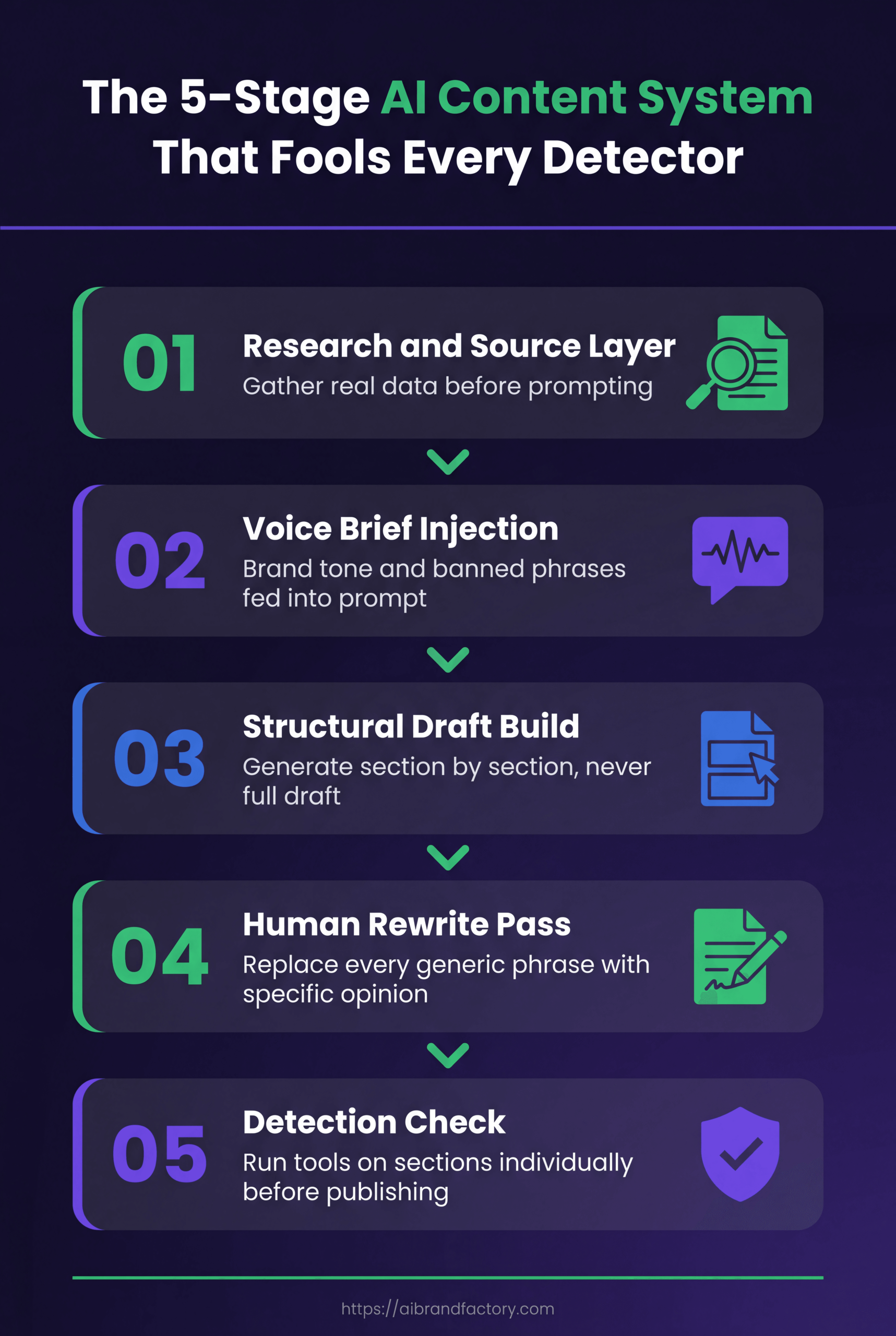
Five stages. Done in order. Every time.
- Stage 1 – Setup
- Stage 2 – Structure
- Stage 3 – Vocabulary
- Stage 4 – Experience injection
- Stage 5 – The quality gate
Stage 1 – Feed AI Context It Cannot Guess
Most people open a blank prompt and type a topic. That’s the mistake. What you give AI before writing starts determines output quality more than any instruction you write. AI learns patterns from examples better than descriptions, as atomwriter.com notes – and that single insight changes how Stage 1 works entirely. Give AI your last five published posts as voice examples. Don’t describe your tone. Show it. Pair that with your audience’s top three objections to the topic. Then add a contrarian angle – something that pushes against the obvious take. This input combination produces output that already sounds closer to your voice before you’ve written a single edit. Stage 1 is the highest-use stage in the whole workflow. Most AI users skip it entirely.
Stage 2 – Use AI for Structure Only, Not Substance
Ask AI for the H2/H3 outline and an opening paragraph scaffold. Nothing else at this stage.
The outline is scaffolding, not the building. Body content comes from your actual knowledge and experience – not from continuing the AI generation. This separation is the core of the system. Most AI users skip Stage 2 and ask AI to write the full post. That’s why their content sounds flat. Structure is AI’s job. Substance is yours.
Stage 3 – Run the Vocabulary Index Pass
This is where AI fingerprints get removed.
- Hedge words to cut: “Essentially,” “notably,” “it’s worth noting,” “” “it is important to note” – these soften claims that belong as direct statements.
- Structural flags: “in conclusion,” “to summarize,” “explore into,” “manage,” “emphasize” – these are AI’s default transition vocabulary.
- Opener patterns: “In today’s fast-paced world,” “As we move forward,” “It goes without saying” – these openers appear in millions of AI-generated pieces.
- Symmetric rhythm – three sentences of nearly identical length back to back signals AI generation even when no specific flagged word is present.
Before/after example showing the exact transformation:
Before (AI-generated): “Content marketing has evolved significantly. Brands must now prioritize authenticity. Readers are more discerning than ever.”
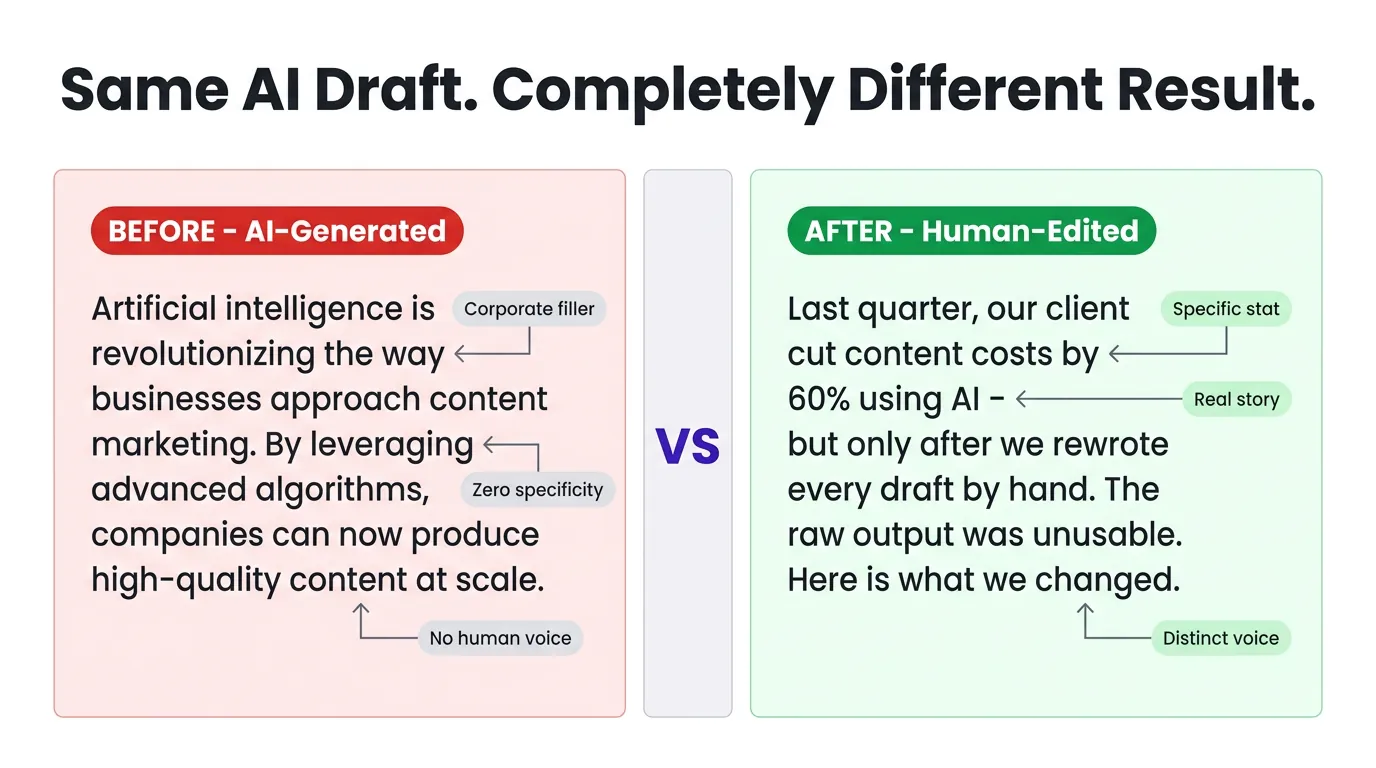

After (humanized): “Content marketing changed. Readers now filter AI content out before the second paragraph – and they’re right to. Authenticity isn’t a trend. It’s the entry requirement.”
The before version hits three AI fingerprint markers in three sentences. The after version breaks rhythm, strips every hedge phrase, and lands a direct assertion. Same information. Different result on detection tools and with readers.
Stage 4 – Inject Personal Experience Into Every Major Section
One real anecdote, one exact personal metric, or one named case study per H2 section. Not once per article. Per section.
Exact metrics beat vague claims every time. “Our bounce rate dropped 34%” is verifiable (New study uncovers why some people le…). “Results improved significantly” is not. Named case studies add authoritativeness AI cannot fabricate on its own. This is the stage that separates content Google rewards from content it ignores. Foundera.co and roboticmarketer.com are direct on this point: authentic experience is what AI cannot supply. The writer supplies it in Stage 4.
Stage 5 – Run the Detection Check Before Publishing
Use GPTZero, Originality.ai, or Winston AI as your quality gate. Target below 15% AI probability on Originality.ai before publishing.
Detection tools aren’t perfect. Don’t treat the score as a guarantee – treat it as a benchmark. A score above 15% means something in the draft still reads as AI-generated. Go back to Stage 3. Find the symmetric rhythm. Find the hedge words. Fix them. Verify every statistic before publishing and attribute each one to a named source. Unverified claims are a trust failure regardless of detection score.

If you want to run this workflow without executing each stage manually, AI BrandFactory’s Blog Writer applies a 7-layer humanization system and an 18-field Voice Profile automatically before the draft reaches you – the workflow baked into the generation, not bolted on afterward.
The AI Fingerprint Vocabulary List You Need to Stop Using Today
These words aren’t just stylistic problems. They’re detection triggers.
Every word and phrase below shows up disproportionately in AI-generated content. Readers catch the patterns without consciously registering why. Detection tools flag them outright.
Words and Phrases That Instantly Flag AI Writing
- Hedge words to cut: “Essentially,” “notably,” “it’s worth noting,” “” “it is important to note.” These soften claims that belong as direct statements.
- Structural flags: “in conclusion,” “to summarize,” “explore into,” “manage,” “emphasize.” These are AI’s default transition vocabulary.
- Opener patterns: “In today’s fast-paced world,” “As we move forward,” “It goes without saying.” These openers appear in millions of AI-generated pieces.
- Symmetric rhythm – three sentences of nearly identical length back to back signals AI generation even when no specific flagged word is present.
What to Replace AI Phrases With
Swap hedge words for direct assertions. Cut the qualifier entirely. “Conversion rates drop” becomes “Conversion rates drop.” Break rhythm by mixing one-sentence paragraphs with longer explanations. Use contractions deliberately – “don’t,” “can’t,” “you’ll” – because AI underuses them. Replace vague transitions with specific connective logic. “This is why the vocabulary pass matters” beats “Furthermore, vocabulary selection is an important consideration.”
Specificity is the replacement pattern. Direct assertion is the replacement tone. Short sentences mixed with longer ones is the replacement rhythm.
How to Apply This System When Using AI to Write Blog Posts and Social Content
The 5-stage workflow applies across formats. The emphasis shifts by format. The stages don’t change.
Adapting the Workflow for Long-Form Blog Posts
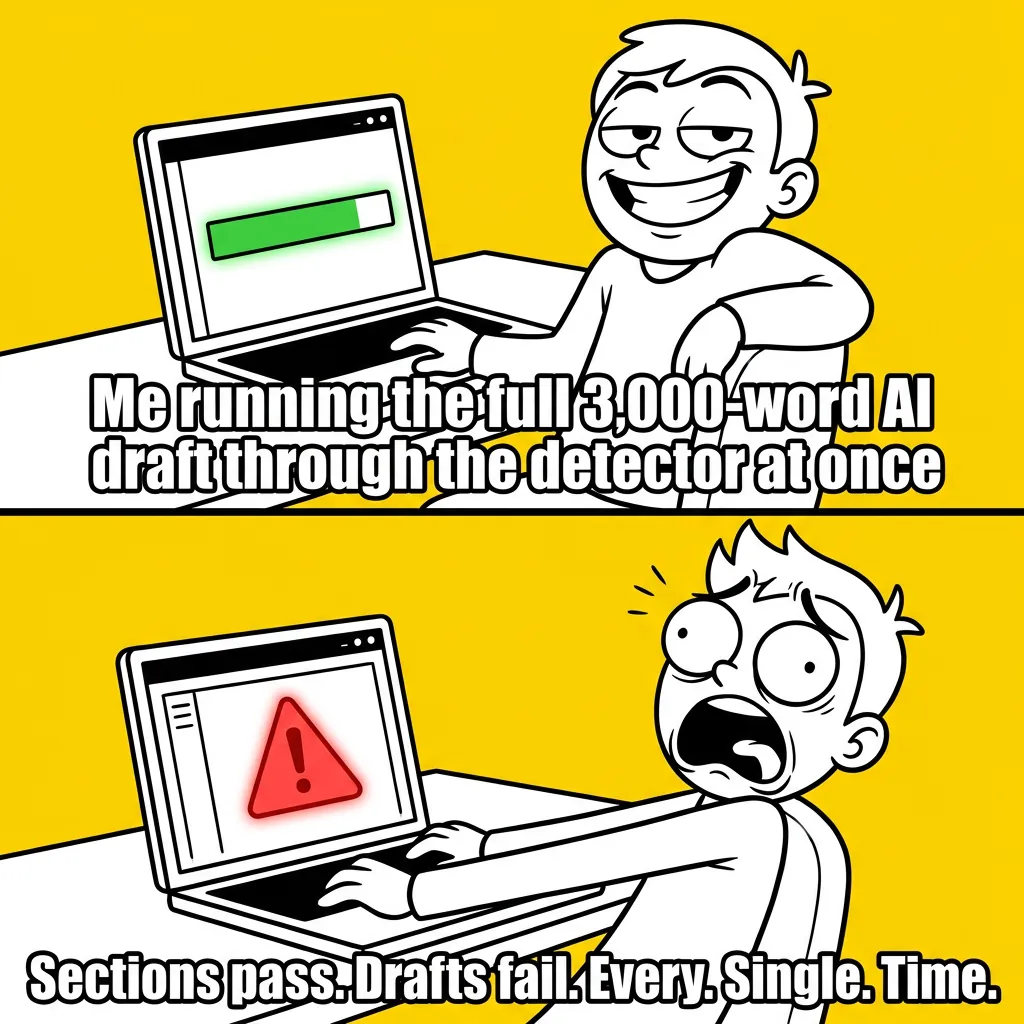
Long-form AI-assisted blog posts should target 2,200 words minimum. Below that threshold, there simply isn’t enough content depth to satisfy E-E-A-T signals across multiple sections. Apply experience injection once per major H2 section – not once per article. A 2,200-word post with four H2 sections needs four experience elements. Run the vocabulary pass on each section independently, not across the full draft at once. Section-by-section passes catch more fingerprint patterns. Run the detection check on the full assembled draft after all sections are complete.
Sections pass individually. Drafts fail together.

Using AI to Write LinkedIn Posts and Social Content Without Sounding Like a Bot
For LinkedIn posts, feed AI your top three performing posts as voice examples before writing anything. Stage 1 discipline matters even more in short-form because there’s no room to recover from a flat opening. Stage 3, the vocabulary pass, carries equal weight. Every word in a 150-word LinkedIn post is visible. One “it’s worth noting” tanks the whole piece. Personal metrics and named outcomes replace long anecdotes in social content. “Our open rate hit 41% after this change” does the same work as a three-paragraph case study in a blog post (The Power of 41%: A Glimpse into the…).
When to Let AI Do More and When to Pull Back
As roboticmarketer.com put it, strong 2026 platforms incorporate company values and tone guidelines directly into content models – not as post-editing instructions but as generative inputs. That’s the direction the field is moving.
As roboticmarketer.com put it, strong 2026 platforms incorporate company values and tone guidelines directly into content models – not as post-editing instructions but as generative inputs. That’s the direction the field is moving.
If you want to run this workflow without executing each stage manually, AI BrandFactory’s Blog Writer applies a 7-layer humanization system and an 18-field Voice Profile automatically before the draft reaches you, with the workflow baked into the generation rather than bolted on afterward. The platform captures 18 structured fields of brand context, audience data, and voice patterns so the output starts closer to human before any manual editing begins. For teams producing content at volume, that’s the difference between a workflow you can sustain and one you abandon after two weeks.
A Pre-Publish Checklist for Every AI-Assisted Article You Write
Two things kill AI content before readers ever see it: skipped stages and skipped verification. This checklist catches both.
The 10-Point Quality Gate Before You Hit Publish
- Vocabulary pass complete – all flagged phrases pulled from every section.
- Sentence rhythm varied – no three consecutive sentences of similar length anywhere in the draft.
- One real experience element per major H2 section – anecdote, exact metric, or named case study.
- All statistics verified and attributed to named sources with links.
- Detection score below 15% on Originality.ai – if above, return to Stage 3.
- Brand voice consistent from opener to close – read it aloud when you’re unsure.
- Meta title includes the primary keyword naturally.
- At least one named external source cited per major claim.
- Internal links placed where relevant.
- Final read-through done at sentence level, not skimming.
Ten points. Non-negotiable.
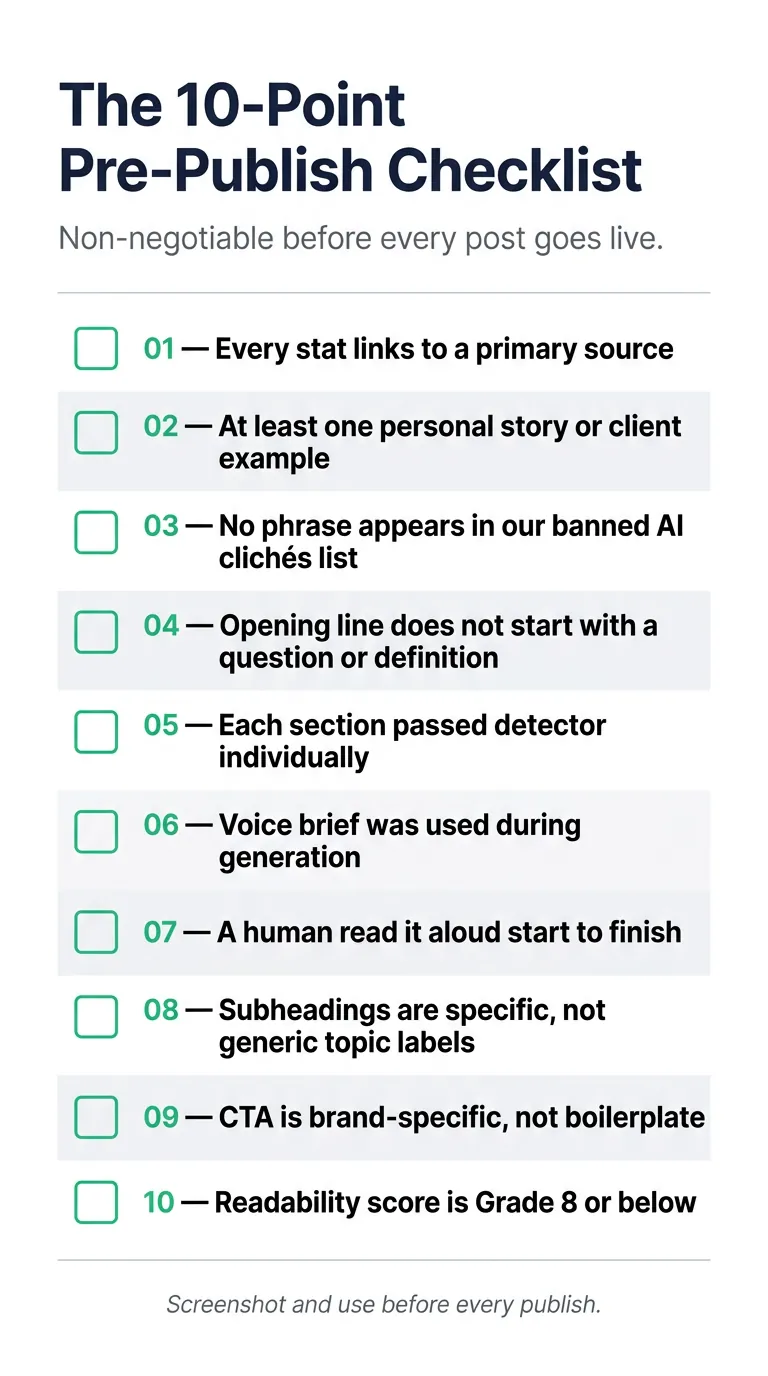

Check five through ten only after one through four pass. The detection score means nothing when the vocabulary pass got skipped. The keyword in the meta title means nothing when the content fails E-E-A-T. Run the checklist in order. That sequence matters.
One more thing: verify every statistic independently before publishing. AI-generated content sometimes includes plausible-sounding figures that don’t check out. “82.1% of Americans” links to roboticmarketer.com. Verify it. “73% of consumers” links to humanizeai.com. Verify it. Attribution without verification is still a trust failure.
Conclusion
AI-written content isn’t the problem. Writing it without a system is. The 5-stage workflow, contextual input, structure-only drafting, vocabulary pass, experience injection, detection check, separates AI content that ranks from AI content that gets buried.
Prompt engineering is a ceiling.
Systematic humanization is the floor you build on. Stage 1 starts today: feed AI your last five published posts and one contrarian angle before writing anything else. That single shift changes output quality before a single word gets edited. The other four stages stack on that base. Run them in order. Every time.
If you want the workflow applied automatically, AI BrandFactory’s Blog Writer applies the 7-layer humanization system and 18-field Voice Profile before the draft reaches you. The system is built into generation, not bolted on afterward.
Start with Stage 1. Build from there.
Ready to build your brand with AI?
One session. A full month of content. Your brand voice.
Request Private Beta Access →