
The 3-Layer Content Workflow Framework Every Marketing Team Needs in 2026
The 3-Layer Content Workflow Framework for Marketing Teams
Most content teams don’t struggle with ideas. The problem is structural. “The challenge for most content teams is not a lack of ideas – it is the volume problem, one person trying to produce the output of six.” The 3-Layer Framework addresses this at the architecture level. Not a content calendar trick.
Start treating every blog post as a source asset, not a finished deliverable.
The Volume Problem Is a Structural Diagnosis Not a Headcount Problem
Hiring more people won’t fix a broken workflow.
Calendar slippage isn’t a motivation problem. It’s a systems problem. When content workflows have no architecture, output stalls regardless of team size.
The symptoms surface quickly. Content production grinds to a halt. Every piece feels like starting from scratch.
- Layer 1 and Layer 2 content feel completely disconnected
- No repurposing happens after publishing
- The content calendar runs two weeks behind
- Team members work in isolation with no shared extraction protocol
Structural symptoms. Not performance failures.
What Calendar Slippage Actually Tells You About Your Workflow
Calendar slippage signals disconnected workflow layers. When foundational content and distribution content operate separately, the whole system falls behind. No repurposing means every piece becomes an isolated effort. Silos form when teams lack a shared extraction protocol.
Why More Tools Make the Problem Worse
Fragmented stacks don’t add capacity. They add coordination overhead. When you write in one tool, schedule in another, and build ads in a third, brand voice breaks at every handoff. The content production workflow becomes a series of disconnected sprints.
More software is not the fix. Architecture is.
Layer 1 Foundational Content Is the Engine That Powers Everything Else
Layer 1 is SEO-driven long-form content, typically a 3,500-word pillar post. A published blog post is not finished when it goes live.
It’s a source asset for 6-10 downstream pieces.
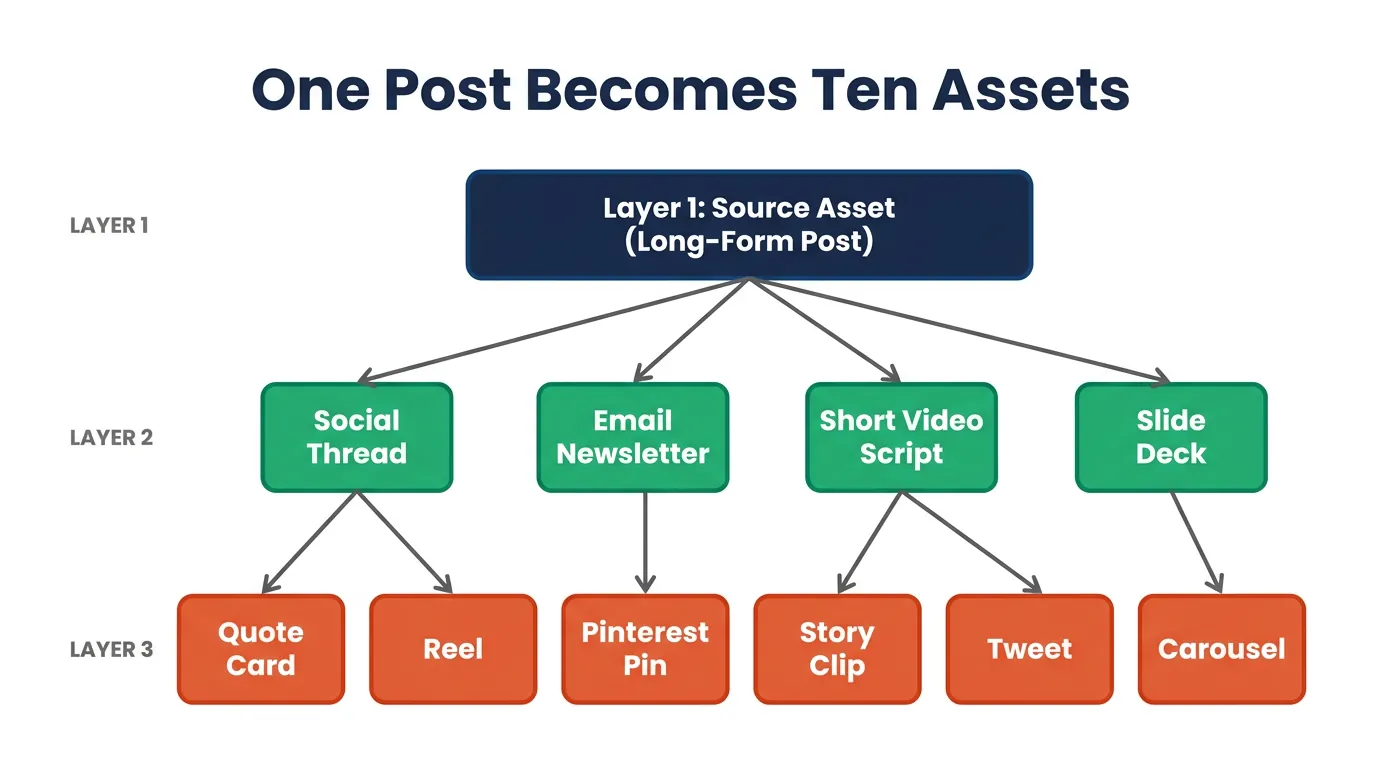

Layer 1 takes 3-6 hours per piece without AI assistance. With a structured brief and AI tools, the target drops below 4 hours. That’s an editorial benchmark, not a published third-party study. Keyword research and your topic brief set the extraction potential of the entire piece.
- Keyword research
- Topic brief
- Outline
- Draft
- Humanization pass
- SEO review
- Publish
- Asset extraction
The 8-Step Layer 1 Production Workflow
Asset extraction is Step 8, and most teams skip it entirely. That’s where the content marketing workflow framework falls apart. Keyword research and the topic brief define what’s extractable later. Humanization and SEO review happen before publishing, not after. The draft without a brief takes longer and produces fewer usable assets. Asset extraction is mandatory, not optional. Without it, Layer 2 never happens.
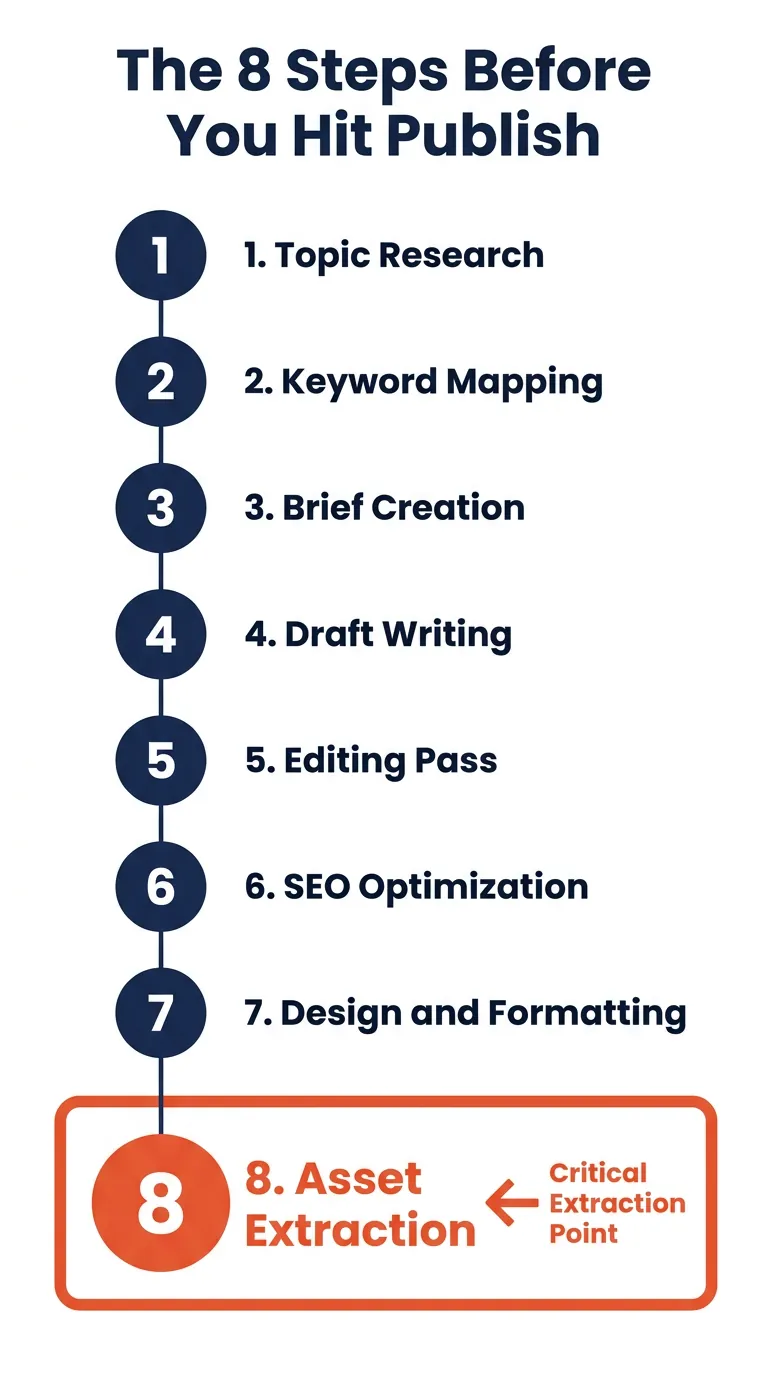

Skipping Step 8 means starting from scratch every time. That’s the volume trap.
How AI Cuts Layer 1 Production Below 4 Hours
AI accelerates three steps most significantly: outline, draft, and humanization pass. The sub-4-hour target requires a structured brief before writing begins. Without the brief, AI output lacks the specificity needed for extraction. This is an editorial target drawn from my own production work, not a benchmark from an external study. Transparency matters here.
Layer 2 Distribution Content Turns One Post Into 12 Assets in 2 Hours
Layer 2 is the repurposing and distribution layer. One Layer 1 post should generate 8-12 finished assets within 2 hours using AI. These are editorial targets from my own workflow, not published benchmarks.
That’s the multiplier the whole framework runs on.
The Extraction Protocol That Generates 8 to 12 Assets Per Post
Start by pulling out 3-5 save-worthy insights from the Layer 1 piece. Those insights become your extraction units, not the full post. From each insight, generate 3-5 carousel slides. From each insight, generate 3-5 social captions. That math produces 9-25 potential pieces from a single post. Target 8-12 finished, scheduled assets per Layer 1 post. The ai content workflow moves through this step fast with the right setup.
Schedule everything before moving to Layer 3.
The One Rule That Protects Your SEO Value in Layer 2
“Layer 2 content should tease and link to Layer 1, not duplicate it.” Duplication kills the SEO traffic loop. Every carousel and caption should build curiosity, not answer the question. Include a link or CTA back to the Layer 1 post in every Layer 2 asset.
When teams use separate platforms for each layer (admittedly, most do), brand voice erodes at every handoff. AI BrandFactory runs Layer 1 production, Layer 2 repurposing, and Layer 3 conversion content from a single brand knowledge base, replacing the fragmented Jasper-plus-Buffer stack entirely. The 18-field brand profile auto-applies to every tool, every generation. Voice stays consistent across all three layers without manual re-briefing.
That’s the infrastructure difference.
Layer 3 Conversion Content Closes the Loop Between Content and Revenue
Layer 3 pulls the highest-converting claims straight from Layer 1. Those claims feed ads, landing pages, and lead magnets.
How to Extract Ad Copy and Landing Pages From a Blog Post
- Pinpoint the highest-converting claims in your Layer 1 post, typically the stat-backed or counterintuitive statements.
- Pull ad copy variations directly from Layer 1 subheadings and key assertions.
- Draw your landing page headline and CTA from that same source material.
- Extract or build the lead magnet referenced inside the blog.
That loop is where content systematization compounds.
Why Brand Voice Breaks Down Between Layers Without a Unified Platform
When Layer 1 is written in Jasper, Layer 2 scheduled in Buffer, and Layer 3 ads built in AdCreative.ai, brand voice degrades at each handoff. AI BrandFactory eliminates this by connecting all three layers within a single brand knowledge base, contrasted directly against that fragmented stack. The 10-agent content pipeline handles the foundational content layer, while the social and ads tools manage distribution and conversion from the same voice profile. No manual re-briefing between layers. No brand drift across formats.
Every tool handoff in a fragmented stack is a consistency risk. A unified platform removes the handoff problem entirely. That’s the architectural fix content teams actually need.
The 3 Metrics That Tell You If Your Content Workflow Is Actually Working
Three metrics tell you whether your content workflow for marketing teams is actually functioning.
Asset Yield Per Post and Time Per Piece Are Your Primary Dials
Asset yield per post measures how many Layer 2 and Layer 3 assets each Layer 1 post generates.The target for asset yield per post is generally accepted to be around 8 to 12.. Asset yield below 4 per post signals the extraction step is being skipped. Time-per-Layer-1-piece above 6 hours signals missing AI infrastructure. Both metrics improve together once the full workflow is installed. These are editorial targets from my own production work, not third-party published benchmarks.
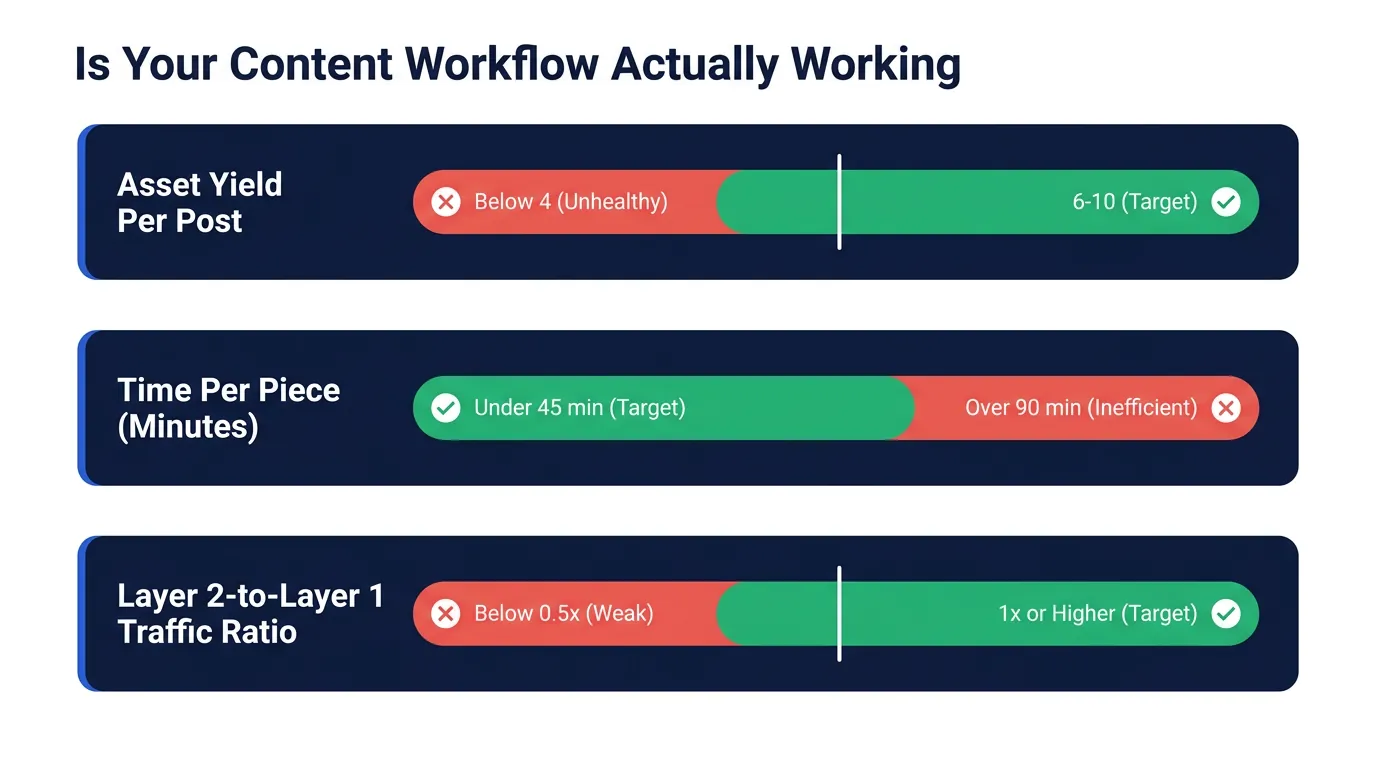

Both dials require upfront setup investment before efficiency gains show up.
The third metric is Layer 2 to Layer 1 traffic ratio. This measures how effectively your distribution content drives readers back to your foundational pieces. A low ratio means Layer 2 is duplicating Layer 1 instead of teasing it.
Track all three metrics monthly. The seo content workflow 2026 demands this level of operational precision. Improvements don’t appear overnight. The framework compounds once the extraction protocol is fully installed and running consistently.
Expect 4-6 weeks before the metrics stabilize.
Conclusion
The 3-Layer Framework is an operational architecture for content systematization, not a calendar shortcut. A published blog post isn’t a finished one.
Take one existing post through all three layers before you produce anything new.
Content workflows that compound over time share a single trait: every Layer 1 piece generates downstream assets systematically. The upfront setup costs something. Once the system runs, the return grows with every post.
Ready to build your brand with AI?
One session. A full month of content. Your brand voice.
Request Private Beta Access →