
Using AI to Create Marketing Content That Actually Converts in 2026
Using AI to Create Authentic Marketing Content That Converts
Your AI content isn’t failing because AI is broken.
Generic prompts produce generic output, every time, no exceptions. The real culprit is missing brand infrastructure, not the technology. A structured 4-pillar production system is what fixes this for good.
The Trust Gap That Makes Most AI Content Fail Before Anyone Reads It
What Happens to Brand Trust When Consumers Spot AI Content
Research indicates that consumers are significantly less likely to trust brands when they identify AI-generated contentg. Meanwhile, 59.9% of consumers now doubt the authenticity of online content. That’s not a niche concern. That’s most of your audience arriving skeptical before reading a single word.Most marketing teams are producing more AI content than ever. Consumer tolerance for it is moving in the opposite direction. This is the gap that quietly kills conversion rates.
The fix isn’t to stop using AI. The fix is to stop using AI badly.
Generic prompts strip out everything that makes your brand recognizable. The output becomes interchangeable with every competitor running the same tool. As one industry analysis framed it: “The authenticity problem is not an AI problem – it is a process problem. Generic AI content feels inauthentic because generic prompts produce generic content.“
Why Generic Prompts Are the Real Culprit
Brand infrastructure is the connective layer most teams skip entirely. Without it, every AI tool you use starts from zero brand context. Authenticity becomes impossible at scale.
The 4-Pillar AI Content Production System That Fixes the Authenticity Problem
Why 52% of Enterprises Are Building Custom AI Content Systems Right Now
Recent research indicates that a significant portion of enterprises are investing in custom AI content systems to enhance brand voice.. They’ve diagnosed the same problem you’re facing. Tool fragmentation – blog content in one platform, social in another, ads in a third – creates brand voice inconsistency across every customer touchpoint.A unified production system replaces that patchwork entirely.
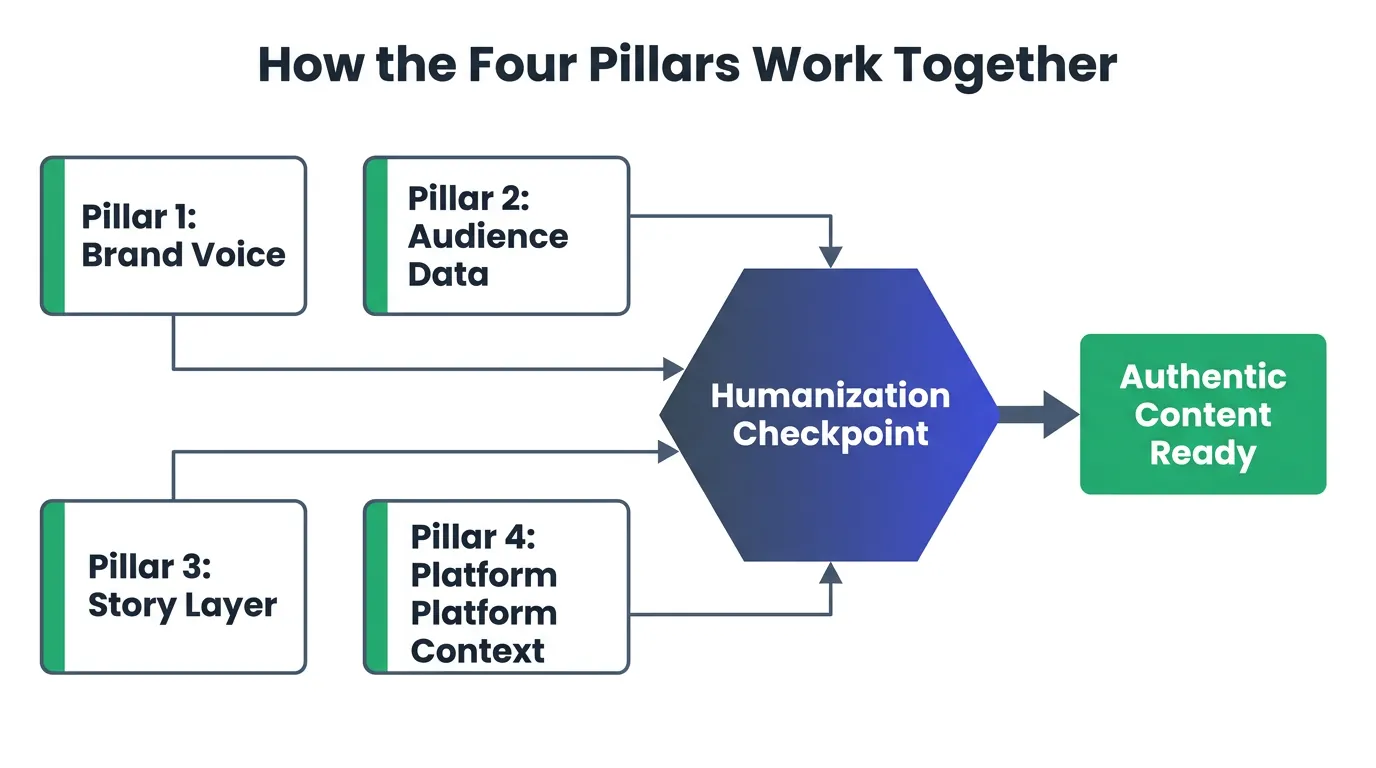
- Pillar 1 – Establishes brand voice as a reusable input layer
- Pillar 2 – Covers blog production with human editorial oversight baked in
- Pillar 3 – Addresses social media content, specifically short-form video
- Pillar 4 – Handles ad copy variant generation and optimization
Each pillar runs through a humanization checkpoint before anything publishes. That checkpoint is what separates 4.1x-performing content from generic AI output.

Pillar 1: Build a Brand Voice Document That Every AI Tool Can Use
The 6 Fields Your Brand Voice Document Must Include to Work With AI
Most brand voice documents are passive. They sit in a Google Doc and get ignored the moment someone opens an AI tool. An AI-ready brand voice document works differently – it functions as a literal instruction set the model can follow.
- Tone rules – written as constraints, not descriptions
- Forbidden terms – explicit lists, not vague guidance
- Competitor positioning – tells the AI what to avoid and what to contrast against
- Target audience profile – gives every generation a specific human to write for
- Value proposition – anchors the content’s purpose
- Compliance requirements – stop brand-damaging or legally problematic output from ever leaving the draft stage
Six fields. Non-negotiable.
How to Turn a Style Guide Into an AI-Ready Infrastructure Layer
The gap between a style guide and brand infrastructure comes down to automatic application. A passive style guide demands manual re-entry into every tool, every session, every team member’s workflow.
AI Brand Factory stores 18 brand context fields and auto-applies them across every content format – blog posts, social content, ad campaigns – without re-briefing each tool separately. That’s what stops brand voice drift as output volume scales. One setup, consistent output across every format.
This is the infrastructure layer that makes authentic AI content creation workflow possible at any volume.
Pillars 2 and 3: How to Produce Blog and Social Media Content That Sounds Human
The Blog Production Workflow That Prevents Generic Output
Load the brand voice document as active context before generating anything – not something you pull up after the fact to double-check.
Structured prompts do the real work before a single word appears. A prompt specifying “B2B SaaS marketing managers, conversion-focused, no jargon, contrarian angle” produces fundamentally different output than “write a blog post about marketing.” Human editorial review is the non-negotiable quality gate, and that’s exactly where the 4.1x performance difference lives. According to autofaceless.ai, AI as a co-creator with human editorial oversight performs 4.1x better than fully automated output.
Sit with that number for a moment.
Why Reels Are the Highest-ROI Social Format for AI-Assisted Teams in 2026
The Meta 2026 Creator Report takes the guesswork out of social media prioritization. Instagram Reels pull 67% more impressions than static posts. Accounts posting 2 or more Reels per week grow 4.2x faster than those posting less.
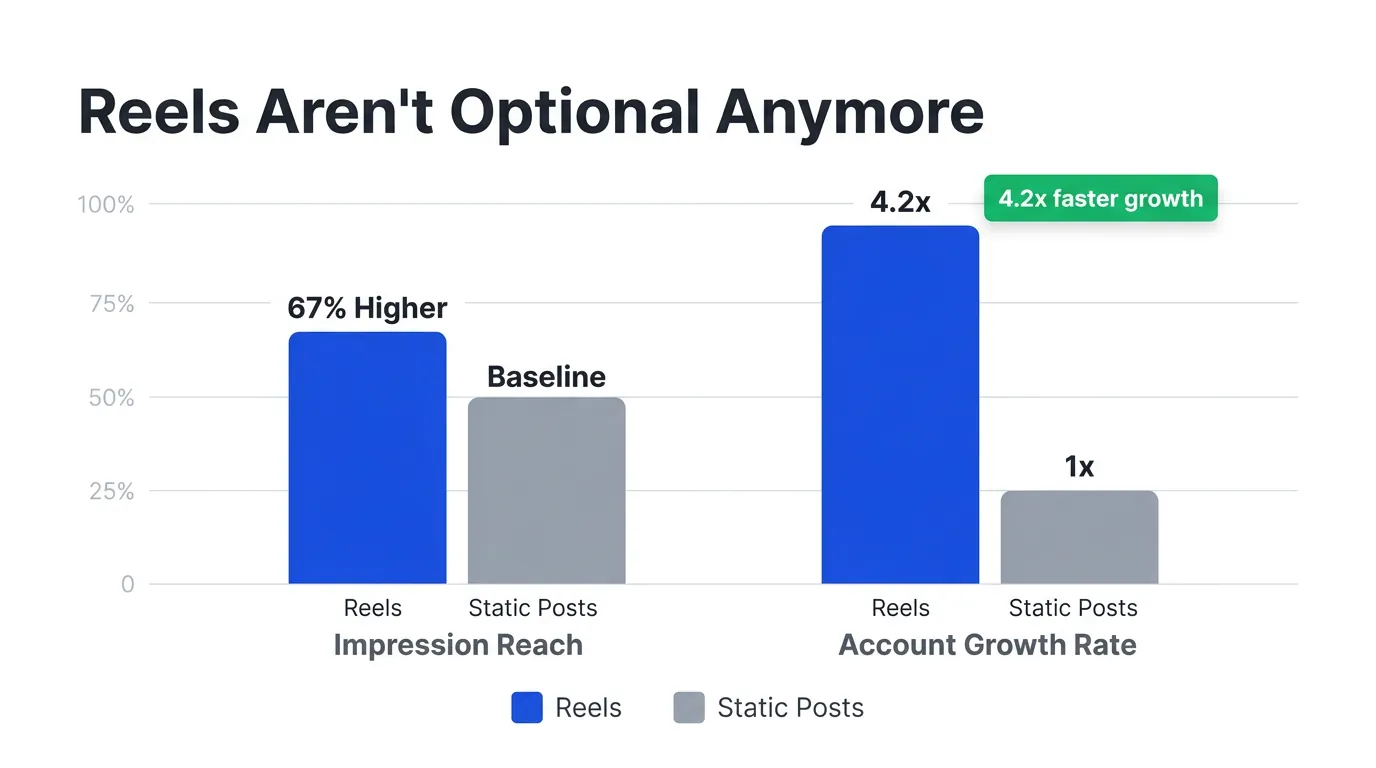

AI handles script outlines and caption variations while the human brings on-camera presence and editorial judgment. When producing content with AI assistance, put your energy toward formats where AI absorbs the production load and humans own the performance side. That division is where efficiency gains actually materialize.
Running a social pillar without Reels means ignoring the highest-ROI format available. Start there.
Pillar 4: AI Ad Copy Optimization and the 30% ROI Lift You Are Leaving on the Table
The Ad Variant Workflow That Turns Brand Voice Into Performance Data
AI produces multiple variants from that single input. A human reviews and selects the top three based on brand judgment, not surface appeal alone. Those three enter platform A/B testing. Real-audience performance data then reveals which brand voice elements actually convert. Over time, this builds a feedback loop that sharpens every subsequent brief and pulls each new generation closer to target.
Start with a brand-voice-informed brief – audience, offer, platform constraints, tone rules, forbidden terms all loaded in.
AI produces multiple variants from that single input. A human reviews and selects the top three based on brand judgment, not surface appeal alone. Those three enter platform A/B testing. Real-audience performance data then reveals which brand voice elements actually convert. Over time, this builds a feedback loop that sharpens every subsequent brief and pulls each new generation closer to target.
Brand voice infrastructure is the prerequisite for any of this to work. Without it, you’re producing variants on an unstable foundation – and whatever performance data comes back teaches you nothing you can carry forward.
The Humanization Checkpoint That Runs After Every Pillar
Vocabulary De-Fingerprinting and Burstiness Restoration Explained
Running AI output through a detector after writing gets the sequence backwards. Humanization belongs inside the production system, not bolted on as a cleanup pass once everything’s done. Two techniques carry the most weight: vocabulary de-fingerprinting and burstiness restoration.
Nail both, and the output reads human.
Vocabulary de-fingerprinting strips out the repeated sentence starters, filler transitions, and default phrases AI gravitates toward across every generation.
Burstiness restoration varies sentence length to match natural human writing rhythm – short punchy sentences mixed with longer explanatory ones, the way people actually write. AI Brand Factory runs a 7-layer humanization process as sequential pipeline steps, built directly into the content engine rather than treated as an add-on tool. Each layer targets a different detection pattern.
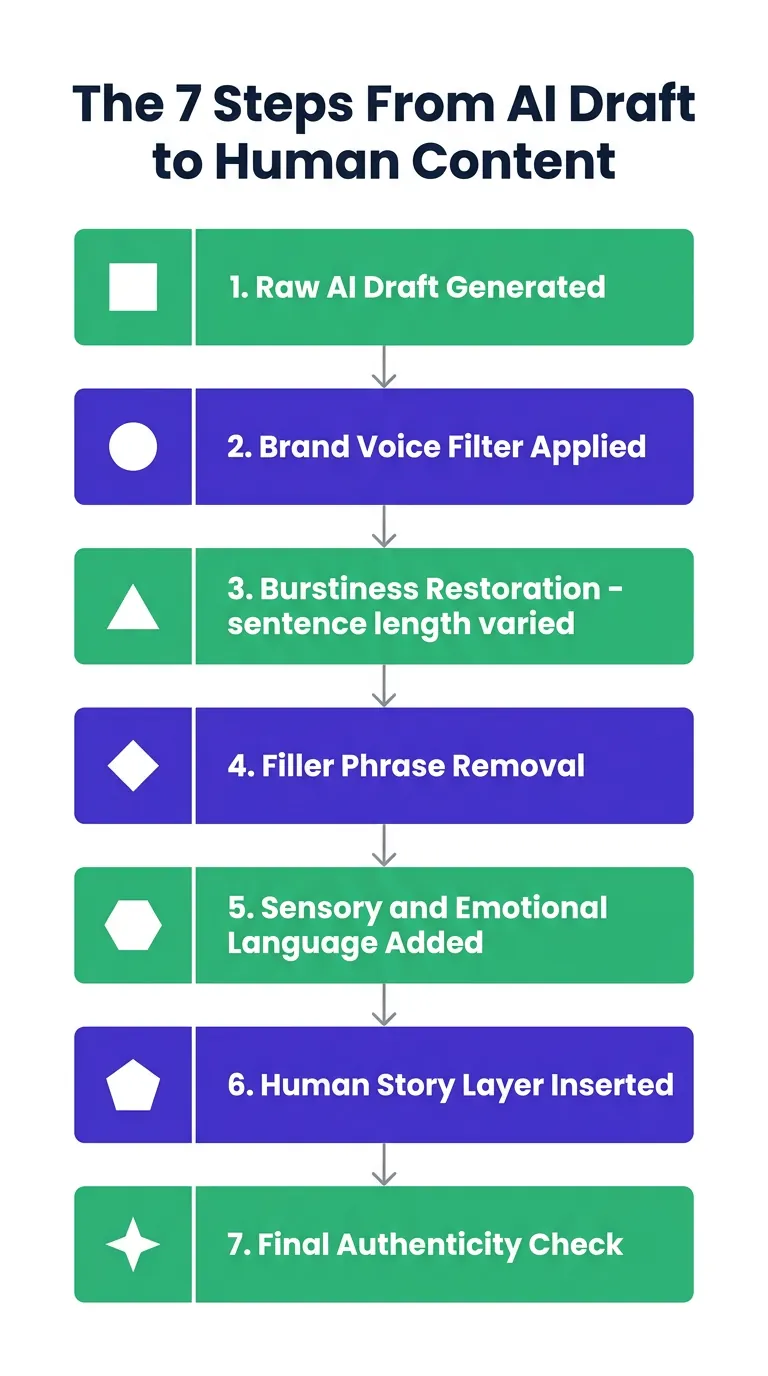

That’s what “baked-in humanization” means in practice. Not a separate tool. A production step.
Conclusion
Authenticity failures in AI content are process failures, and process failures are fixable. The 4-pillar system gives you the structure to fix them systematically.
Build the brand voice document first.
Everything else depends on that foundation being solid. Human editorial oversight at each pillar is what separates content that converts from content that erodes trust. Systematize your AI-driven content creation, and the 4.1x performance lift stops being a statistic and starts being your baseline.
Ready to build your brand with AI?
One session. A full month of content. Your brand voice.
Request Private Beta Access →