What Is a Content Calendar? The 2026 Guide for Marketing Teams
Monday morning. You need to post something today, and your mind is completely blank.
That’s reactive posting, and it’s quietly gutting your content strategy.
Grasping what a content calendar actually is starts with recognizing this exact problem. A content calendar swaps the scramble for a system. Once you have one, Monday mornings stop feeling like emergencies.
This guide covers every type, every essential field, and every benefit. You’ll also get a concrete checklist to build your first calendar today. No overwhelm, no theory, just a clear path forward.
The Real Definition of a Content Calendar (Not the Boring Textbook Version)
Most people picture a content calendar as a spreadsheet with dates on it. Wrong. It’s a strategic publishing system that ties your content directly to actual business goals.
That phrase “organized by publish date and platform” carries real weight. A random pile of topics isn’t a calendar. A calendar connects each piece of content to a specific channel, a specific date, and a specific audience.
So, what is content calendar planning really about? It’s the act of making those connections on purpose rather than by accident. Strip away that structure and content decisions fall back on gut feeling instead of strategy.
Platform context shifts everything. A LinkedIn article and an Instagram reel serve completely different audiences.
Why a Content Calendar Is Not Just a Fancy To-Do List
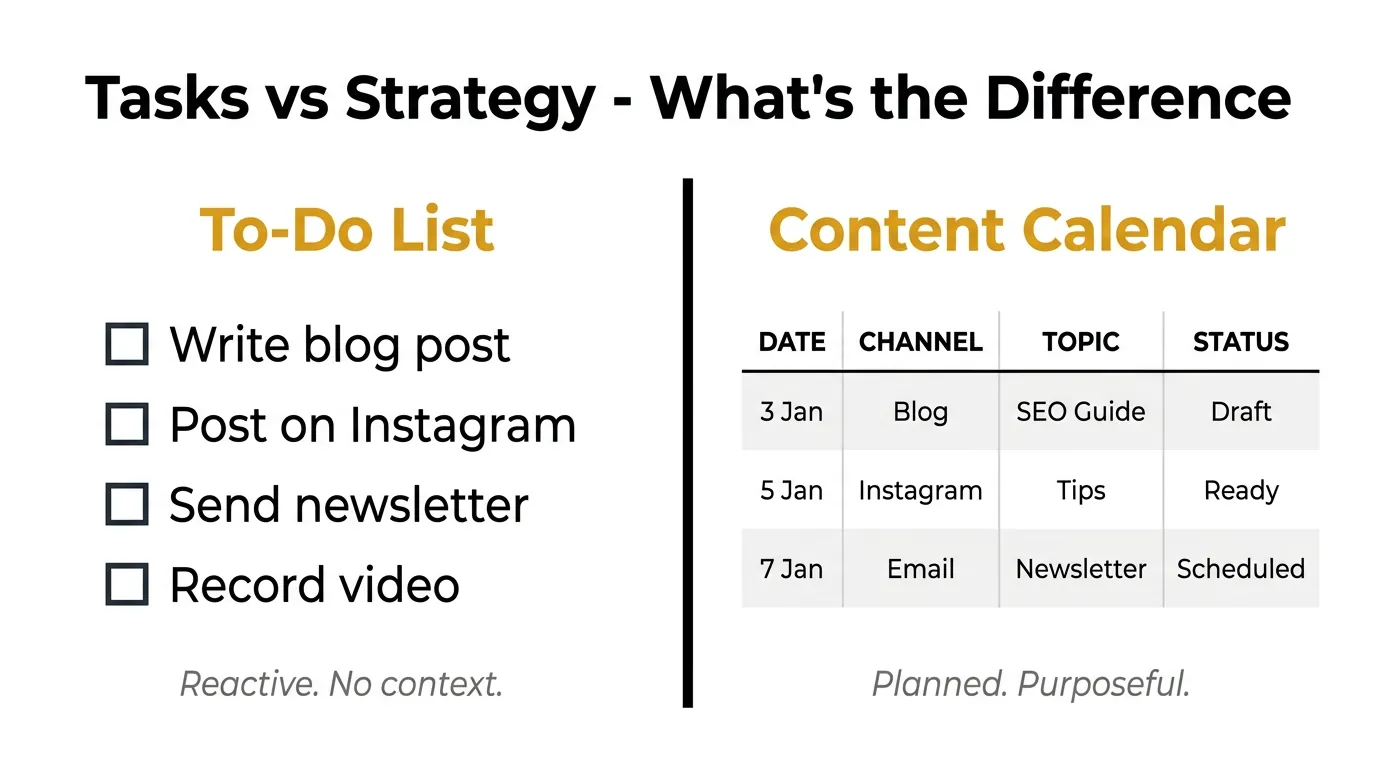
A to-do list tracks tasks waiting to get done. A content calendar maps what you publish, where you publish it, and when. Fundamentally different things.
Tasks vs Strategy: To-Do List vs Content Calendar Educational Diagram
A task list might say “write a blog post.” A calendar says “publish a 1,200-word SEO post on Tuesday targeting first-time buyers on the company blog.” The second version carries strategic weight. The first version just carries guilt.
Editorial Calendar vs Content Calendar – What the Difference Actually Means
Editorial calendars grew out of print publishing. Magazines relied on them to plan articles, issues, and contributor deadlines. The focus was long-form written content, full stop.
A content calendar is the modern, broader version. It covers blog posts, social media, video, email, ads, and everything in between. Most marketing teams use both terms interchangeably in practice. Knowing the distinction helps you speak the industry’s language with precision.
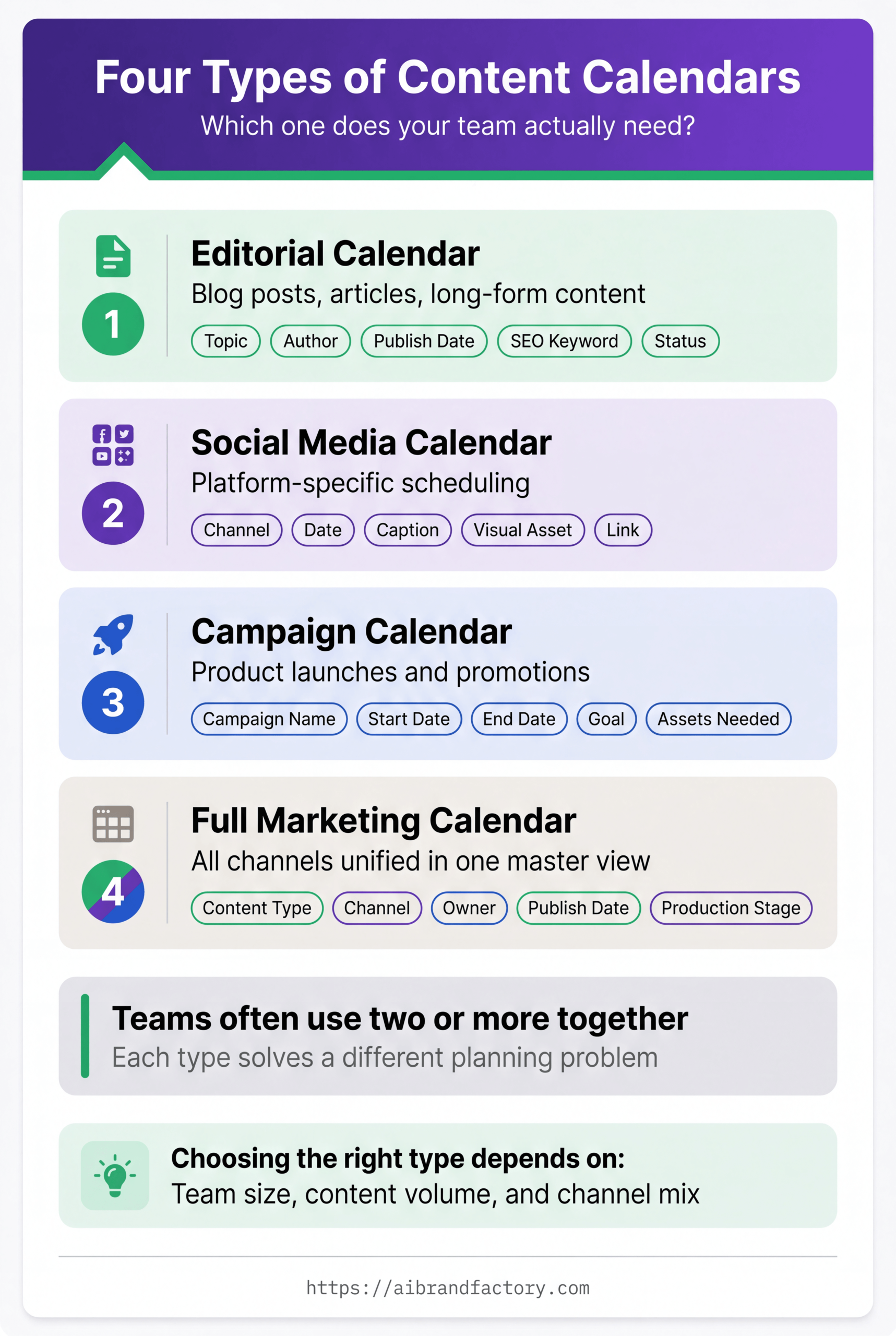
The Four Types of Content Calendars Every Marketing Team Should Know
Not every calendar fits every content type. Different formats demand different fields. Four main types exist, and each one works differently.
Four Types of Content Calendars – Educational Infographic
Social Media Calendar – The Fields That Keep Posts from Falling Through the Cracks
A social media calendar without the right columns is just a list of intentions. The columns that actually matter are platform, date and time, format, caption, hashtags, CTA, and status.
Each field earns its place. Platform and format fields stop you from cross-posting a vertical video to a platform that doesn’t support it. The status column is what turns a passive list into an active workflow.
Without a status column, nothing moves.
Blog and Editorial Calendar – How to Track Every Post from Idea to Published
A blog calendar needs these columns: post title, primary keyword, target publish date, writer, editor, status, and internal links.
A filled-in row looks like this in practice. Post title: “How to Choose a CRM for Small Businesses.” Primary keyword: “best CRM for small business.” Publish date: July 8. Writer: Sarah. Status: In Review. Internal link target: pricing page. That single row tells your whole team exactly where that post stands.
The primary keyword column bridges your calendar and your SEO strategy. Without it, you’re publishing blind.
Video and Email Calendars – The Fields That Make Them Different
Video calendars need fields that blog calendars skip entirely. Upload frequency, title, script outline, thumbnail concept, and SEO tags all belong in a video content calendar. Script outline and thumbnail concept columns prevent the last-minute chaos that derails video production consistently.
Email calendars reflect the personalization demands of email marketing. Subject line, segment, CTA, send date, and A/B test variant are the core fields. The segment field forces you to think about who receives each email before you write a single word. A/B test variant columns build experimentation into the workflow from the start.
A video calendar without a script outline column is incomplete. An email calendar without a segment field is just a broadcast list.
What a Content Calendar Actually Does for Your Results
A content calendar isn’t just an organizational tool. It’s a performance lever.
How Consistent Publishing Builds SEO Rankings and Audience Trust
Search engines reward consistent publishing signals over time. Publish on a reliable schedule and search algorithms start recognizing your site as an active, authoritative source. Audiences work the same way. They come back when they know content shows up predictably.
According to Planable.io research on AI and content creation, A recent study found that a significant percentage of social media professionals believe AI improves their content production efficiency.. That stat carries weight because consistency used to demand large teams. A solo operator with the right tools can now publish at team-level frequency without burning out.
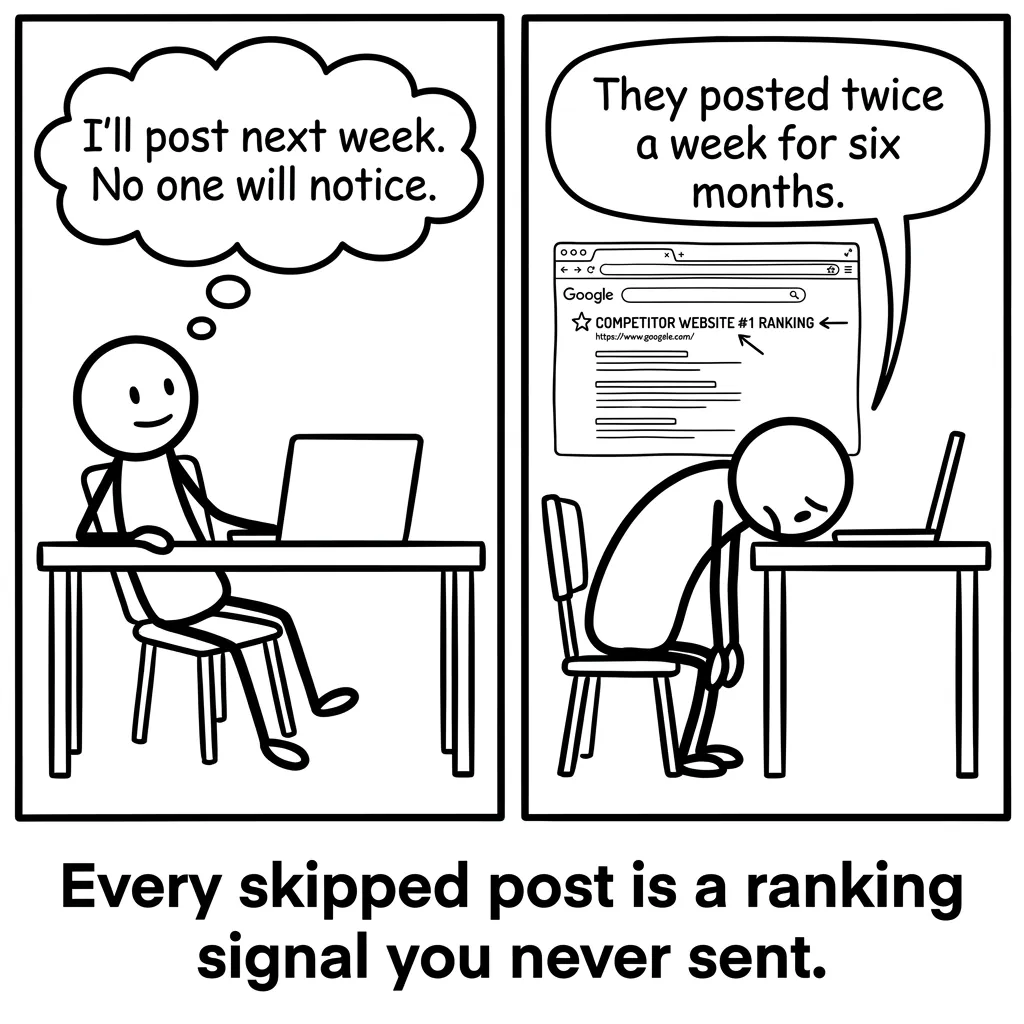
The compounding effect of regular publishing is real. Every post you skip is a ranking signal you never sent.
Skipping Posts Costs You Rankings – Stick Figure Meme Comic
Why Teams That Plan Together Stop Duplicating Each Other’s Work
Shared calendar visibility stops two writers from covering the same topic in the same week. Sounds obvious, but it happens constantly on teams without a central planning document. Approval status columns replace the endless email chains.
A shared calendar is a single source of truth. Everyone knows what’s live, what’s in review, and what hasn’t been touched yet.
What Your First Content Calendar Should Actually Include
The Minimum Viable Calendar Every Beginner Can Start With Today
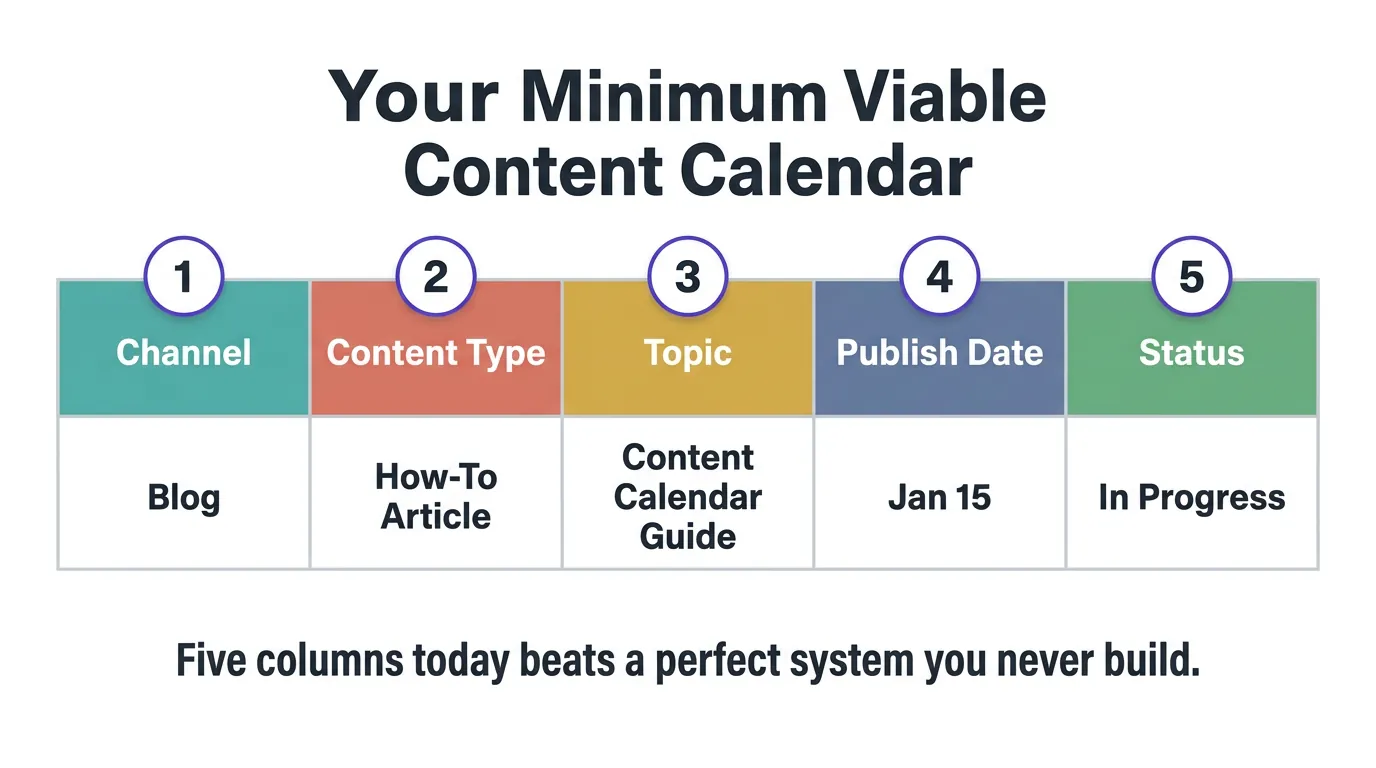
Five columns. That’s your starting point. Channel, content type, topic, publish date, and status.
Each one pulls its weight. Channel trains you to think in platform-native terms from day one. Content type keeps you from scheduling a podcast episode when your entire workflow is built around writing. Status transforms the whole thing from a static wish list into something you actually work from.
Complexity comes later. Five columns today beats a perfect system you never build. The channel column matters most for beginners specifically because it anchors every content decision to a real platform before a single word gets written. What does a content calendar template look like at its most basic? Those five columns in a spreadsheet you open every week. Fancy tools are beside the point right now. Consistency isn’t.
Your Minimum Viable Content Calendar: Five-Column Spreadsheet Template
Start today. Imperfect and moving beats perfect and frozen.
What Filling In One Real Row Actually Looks Like
A blog post row might look like this: Topic: “What Is a Content Calendar,” Publish Date: June 24, Writer: You, Status: Draft, Internal Link Target: Services page.
A social post row looks different: Platform: Instagram, Format: Carousel, Caption Draft: “5 columns every content calendar needs,” Hashtags: #contentmarketing #socialmediatips, CTA: “Save this post,” Scheduled Time: Tuesday 9am, Status: Scheduled.
Placed side by side, those two rows show how different channels demand different fields. The blog row tracks creation and SEO intent. The social row tracks execution and platform logistics. Seeing both filled out makes the whole system feel tangible and real. Most beginners stall because the calendar stays abstract right up until they populate one actual row.
The One Problem a Content Calendar Cannot Solve on Its Own
A calendar tells you when to publish. Not what to write.
Why a Full Calendar Still Leaves You Staring at a Blank Page
Most first-time calendar builders fill in topic slots and feel productive about it. Then Tuesday rolls around, the slot reads “blog post on email marketing,” and the blank page wins anyway. The calendar organized the when, not the how.
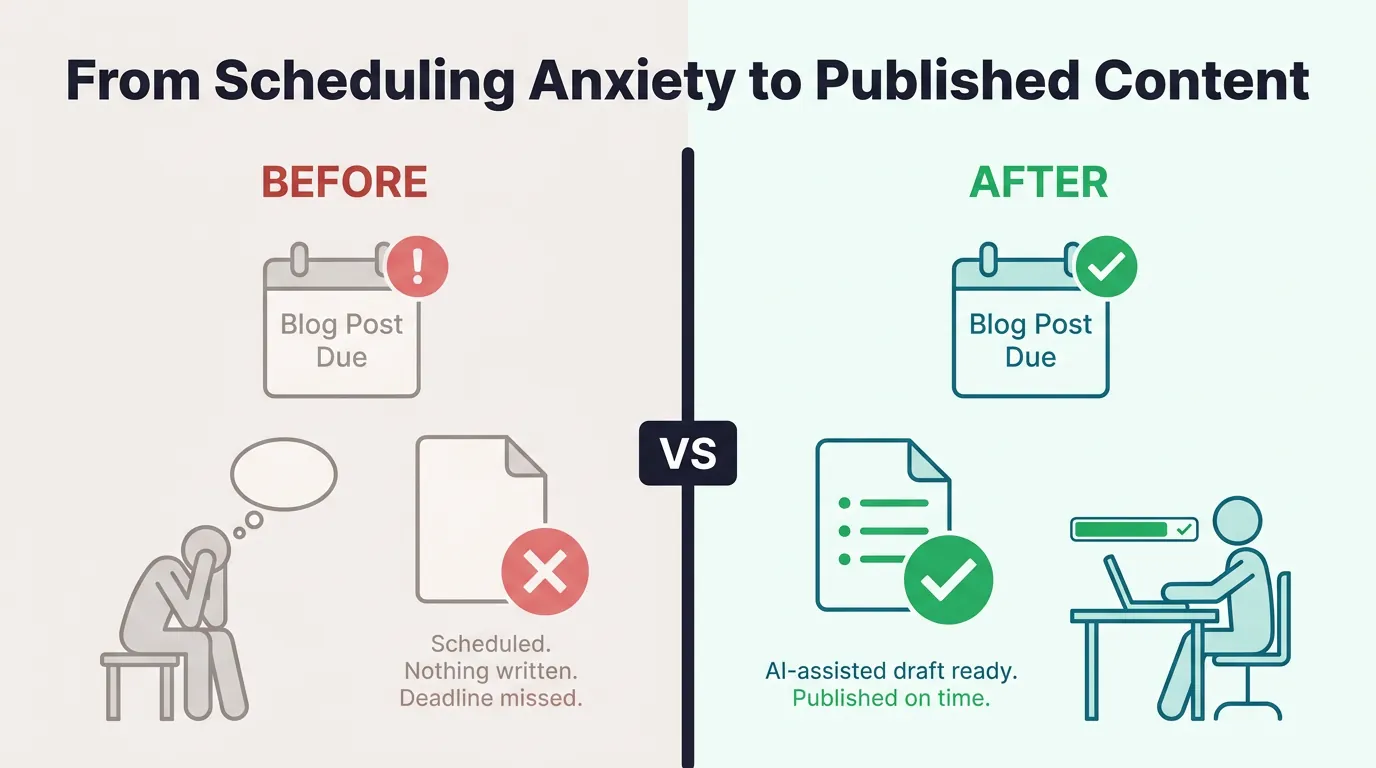
That gap between a topic label and a finished draft is where most content calendars quietly collapse. It’s the most common reason people abandon their planning systems entirely. What is content calendar planning worth if creation never actually happens? Planning without production is just scheduling anxiety.
Before and After: Scheduling Anxiety vs. AI-Assisted Blog Publishing
The calendar is not the content.
For the production layer, AI BrandFactory sits directly on top of your calendar. Not a replacement for planning. It’s the tool that fills your calendar slots with finished, on-brand content. You bring the schedule, it brings the finished draft. The calendar tells you what to publish and when. AI BrandFactory handles everything that comes after.
That’s the gap most marketing teams never close.
How AI Tools Are Closing the Gap Between Planning and Publishing in 2026
AI tools in 2026 don’t just speed up writing. They collapse the distance between a calendar slot and a finished, publish-ready piece. Planning and production used to run as separate workflows requiring separate people. That separation is disappearing fast.
A recent survey found that a significant percentage of social media professionals believe AI enhances their content creation efficiency.. That number reflects a genuine shift in how marketing teams operate. Solo operators are now producing at agency volume. Small teams are hitting publishing schedules that once required full departments.
The calendar gives you the plan.
AI BrandFactory gives you the finished content that fills it. The Voice Profile feature captures your tone, formality level, and writing patterns across 18 fields before a single word gets written. The Blog Writer then produces a humanized draft that sounds like you, not a template. When your calendar says “publish Tuesday,” you’re not staring at a blank page. You’re reviewing a finished draft that already sounds like your brand.
Conclusion
A content calendar pulls you out of reactive mode and into something strategic. That shift alone changes what your content can actually do for your business.
Start there.
Pick one channel, open a spreadsheet, add five columns: channel, content type, topic, publish date, status. That’s your first content calendar, and it’s enough. The calendar owns the when. A tool like AI BrandFactory owns the what. No perfect system required. Just a working one.